
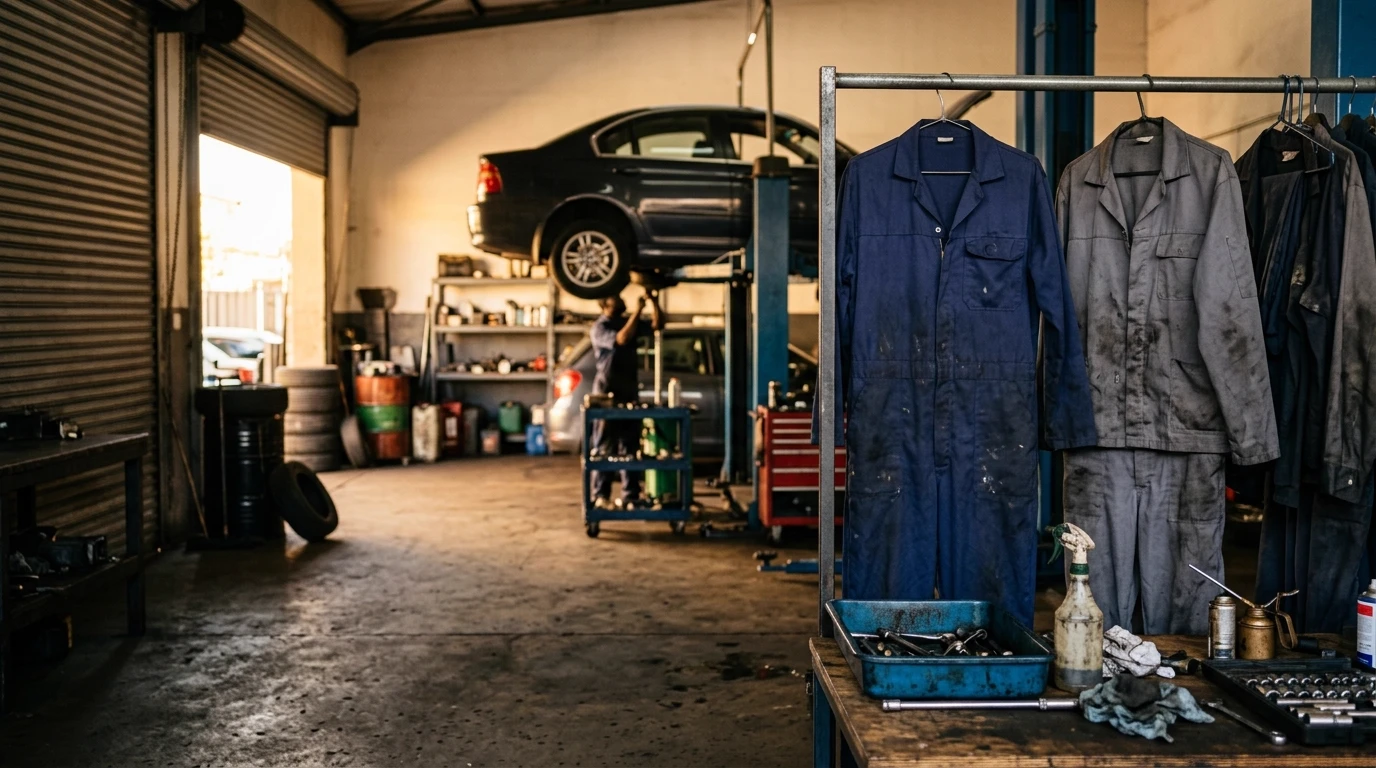
Buy by role, not by headcount. Technicians who work under vehicles need one-piece overalls; staff in a hot bay are better off in a two-piece conti suit; the service counter needs a branded golfer. As of September 2026, BMC Manufacturing lists an overall jumpsuit at R800 and an acid-resistant overall at R850. Embroider the branding rather than print it.
Last updated 28 September 2026. Prices are from BMC Manufacturing’s published price list on that date and are indicative — they vary with fabric, quantity and specification. The SANS 434 scope was checked on the SABS webstore the same day.
Most workshops do not choose their overalls. They inherit them — from whoever quoted cheapest the last time somebody left and a new technician needed kit by Monday.
This guide is for the workshop owner or service manager buying for a team of five to fifty: what to put on whom, which fabric survives degreaser, when acid resistance is worth paying for, and what it costs. BMC Manufacturing (Pty) Ltd makes workshop overalls in Doornfontein, Johannesburg, so we have a stake in the answer. Where a shop-bought overall is the better call, we say so.
- One-piece overall
- R800 per unit on our list — best coverage for work under a vehicle.
- Acid-resistant overall
- R850 per unit — for battery work and parts washing, not for every bay.
- Heavy work shirt
- R400 short sleeve, R500 long sleeve (listed as our mining shirt).
- Service-counter golfer
- R300 for a bird-eye golfer, embroidered with the workshop’s mark.
- The general-workwear standard
- SANS 434 covers the material, cut, make and trim of boiler suits, two-piece suits and overalls.
- Branding
- Embroidery outlasts print once solvents and hot washing get to a garment.
Should a mechanic wear a one-piece overall or a conti suit?
One-piece for anyone who spends the day under a car; two-piece for everyone else. A one-piece overall has no gap at the waist, so nothing rides up when a technician lies on a creeper. A two-piece “conti suit” is cooler and lets you replace only the half that wears out.
Picture a technician on a creeper at 2pm in January, reaching up into a gearbox. A shirt tail pulls loose, the back is on the concrete, and that is the day a one-piece earns its money.
| Garment | Best for | Weak point | Our list price |
|---|---|---|---|
| One-piece overall (boiler suit) | Pit work, under-vehicle work, new starters | Hot in summer; the whole garment goes when one knee wears through | R800 |
| Acid-resistant overall | Battery handling, parts washing | Costs more and is unnecessary for general service work | R850 |
| Two-piece conti suit | General service, hot bays, mixed work | Gap at the waist when lying down | Not on our public list — ask us for a current figure |
| Work shirt and trouser | Foremen, road-test drivers, lighter duties | Least coverage; trousers often mismatched | Shirt R400–R500; trousers quoted per job |
Prices are indicative and may vary based on specific requirements. Bulk discounts apply from 100 units, with better rates at 250 and 500.
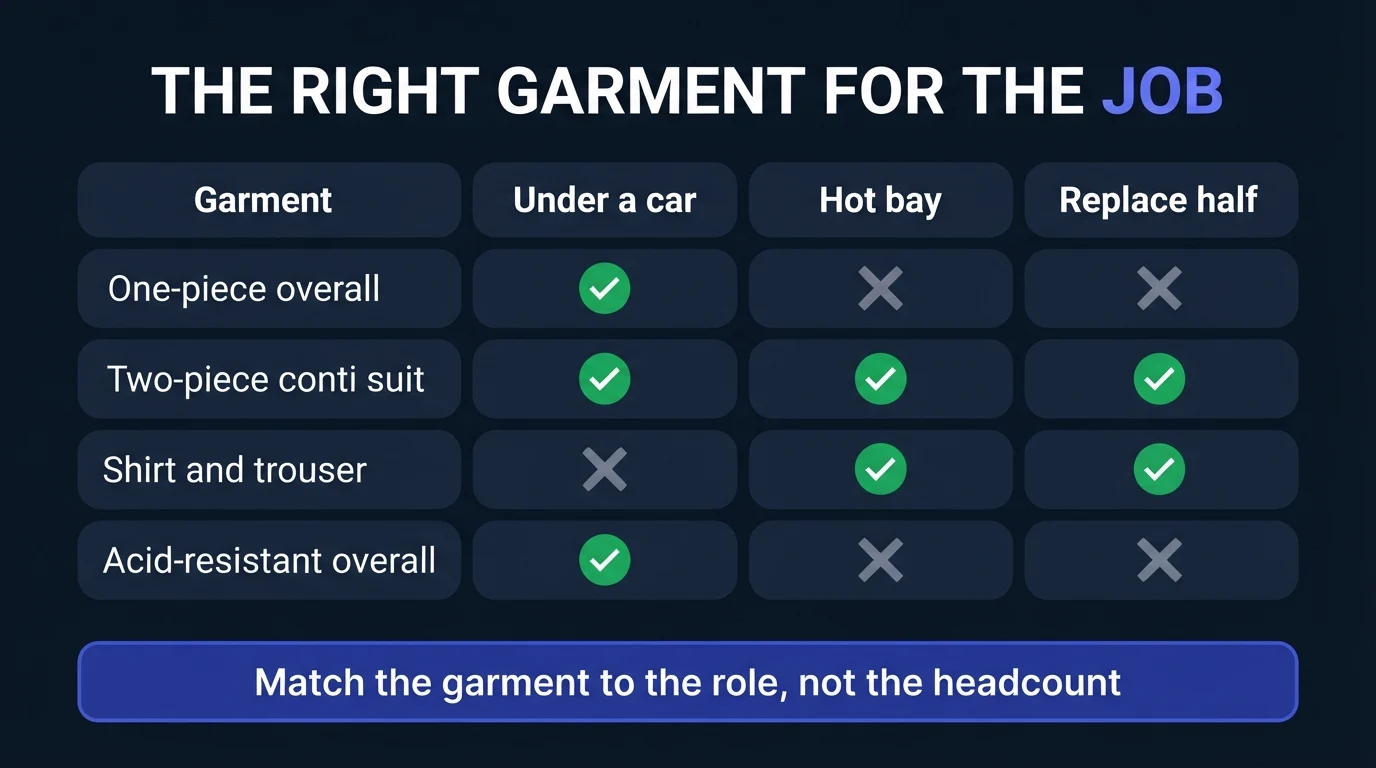
Most workshops land on a mix: one-piece for the pit, two-piece for general service. That is two garments on the order, which is fine — a manufacturer can cut both from the same fabric and colour, so the team still looks like one team.
What fabric actually survives degreaser and sparks?
Polycotton survives the wash better; cotton is the safer choice near sparks. That trade-off decides most workshop fabric choices, and the right answer depends on whether anybody on your floor grinds or welds.
- Polycotton (a polyester and cotton blend) resists abrasion, holds its colour through repeated hot washing, dries quickly and creases less. It is the usual choice for general service work.
- 100% cotton breathes better in a hot bay and chars rather than melts when a spark lands on it. It absorbs oil more readily and fades faster.
- Fabric weight, quoted in grams per square metre (gsm), decides durability. Heavier cloth lasts longer and is hotter to wear. Ask any supplier for the composition and gsm in writing, not just the colour.
Polyester fibres melt when hot metal hits them, and melted fibre can stick to skin. Neither standard polycotton nor ordinary cotton is flame-retardant. If anyone on your floor welds or cuts, specify a flame-retardant garment for that person and ask what it is tested to — do not rely on the everyday overall.

When does a workshop actually need acid-resistant overalls?
When somebody handles batteries or acid-based cleaners every week — not otherwise. Acid-resistant overalls are built to shed a splash that would eat through an ordinary garment. For a general service bay they are money spent on a risk you do not have.
On our list the gap is small: R850 against R800 for a standard overall jumpsuit. So the case for buying them is about the job, not the price. Give them to the battery bench and the parts-washing station, and keep standard overalls for everyone else.
“Acid-resistant” is not “acid-proof”. Ask any supplier, us included, what the garment has been tested against and whether they can put that in writing. If your client or site specification names a particular standard, send it to us before we quote and we will tell you plainly whether we can meet it.
What does it cost to kit out a small workshop?
Roughly R1 600 per technician for two overalls, and R600 per service advisor for two golfers, on our September 2026 list. Two each is the practical minimum — one on, one in the wash.
| Role | Garment | Unit price | Two each |
|---|---|---|---|
| Technician | Overall jumpsuit | R800 | R1 600 |
| Battery or parts-washing bench | Acid-resistant overall | R850 | R1 700 |
| Foreman or road-test driver | Heavy work shirt, long sleeve | R500 | R1 000 |
| Service advisor | Bird-eye golfer | R300 | R600 |
| Washbay or apprentice | Round neck (bird eye) | R250 | R500 |
| Roadside recovery | Traffic / reflective jacket | R350 | R350 (one each) |
So a workshop with six technicians and two advisors is looking at about R9 600 plus R1 200 before any discount. Prices may vary based on specific requirements, and a written quote is the firm number.
Be straight with yourself about the alternative. If you need three plain overalls by Friday and do not care about branding, an off-the-shelf workwear store is probably the faster and cheaper answer. A manufacturer earns its place when you want matching, branded kit you can re-order in the same fabric a year later.
Is embroidered or printed branding better on workshop overalls?
Embroidered, for anything worn in the bay. Printed logos sit on the surface of the fabric, and solvents and hot industrial washing tend to lift or crack them. Embroidery is stitched into the garment, so it lasts as long as the fabric does.
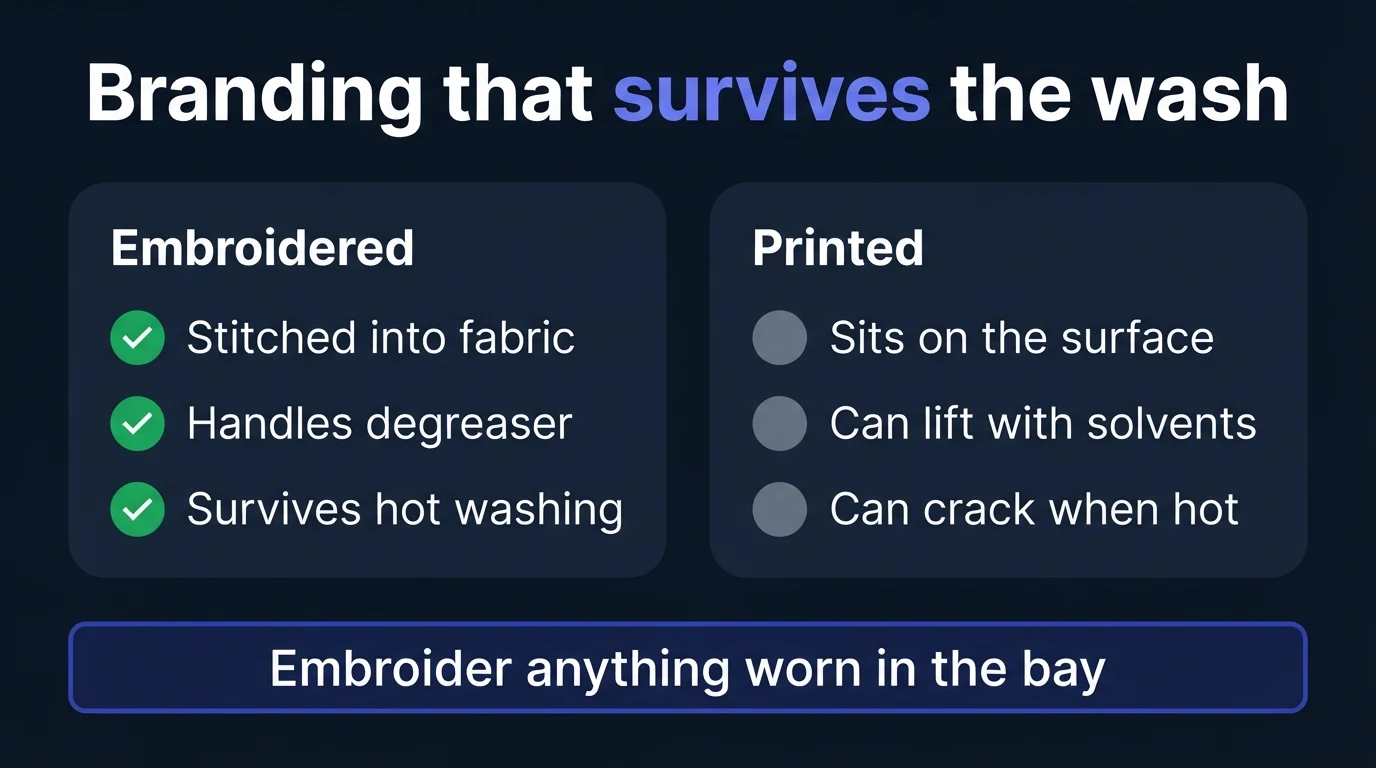
The same logic applies to name badges. An embroidered name tape survives; a printed name on the chest is usually unreadable within months. For a workshop with regular staff turnover, a separate sewn-on name tape means the overall can be re-issued to the next person.

Embroidery carries a once-off setup cost to digitise your logo, spread across the order. That is why ten garments carry it far better than two — and why, once a manufacturer holds your file, top-ups get cheaper to run.
What should you ask an overall supplier before you order?
Six questions, in writing, before you pay a deposit. They are the same ones we would want a buyer to ask us.
-
What is the fabric composition and weight?
Polycotton or cotton, and the gsm. “Heavy duty” is not a specification.
-
Is it made to SANS 434, and is that certified?
SANS 434 is the South African standard for general workwear. “Made to” and “certified to” are different claims — ask which one you are getting.
-
Can I see and wear a sample first?
Put it on a technician for a full shift before you sign off the batch.
-
How is the branding applied?
Embroidery or print, and who holds the logo file afterwards.
-
Can I re-order three in the same fabric next year?
A cheap first order is expensive if the fabric is discontinued when you need a top-up.
-
What is the lead time, in writing?
Any supplier’s turnaround moves with their load. Get the date on the quote, not in a phone call.
If you are in Johannesburg, our mechanic uniforms page for Johannesburg workshops covers delivery to Selby, City Deep and Booysens — and you can come and look at the fabric in Doornfontein before you commit. The full range sits on our corporate and PPE workwear page, and finished orders are in the production gallery.
- Issue garments by role: one-piece for under-vehicle work, two-piece for general service, golfers for the counter.
- Our September 2026 list: R800 overall jumpsuit, R850 acid-resistant, R300 golfer — indicative, varying with specification.
- Polycotton for durability; cotton or flame-retardant for anyone near sparks.
- Acid-resistant overalls belong on the battery bench, not the whole team.
- Embroider the branding; print does not survive degreaser.
- Get fabric, standard and lead time in writing before you pay.
Common questions
How much do mechanic overalls cost in South Africa?
As of September 2026, BMC Manufacturing lists a one-piece overall jumpsuit at R800 and an acid-resistant overall at R850. These are indicative per-unit prices that vary with fabric, quantity and specification. Bulk discounts apply from 100 units, with better rates at 250 and 500. Plain, unbranded overalls from an off-the-shelf workwear store may cost less.
What is the difference between an overall and a conti suit?
An overall, or boiler suit, is one piece from collar to ankle, so nothing rides up when a technician lies under a vehicle. A conti suit is a two-piece jacket and trouser set in the same fabric. It is cooler to wear and lets you replace only the half that wears out, usually the trousers.
Are polycotton overalls safe for welding or grinding?
Not on their own. Polyester fibres melt when hot metal lands on them, and melted fibre can stick to skin. Cotton chars rather than melts, but ordinary cotton is not flame-retardant either. Anyone who welds, cuts or grinds should wear a flame-retardant garment specified for that work, and you should ask what it is tested to.
What is SANS 434?
SANS 434 is the South African National Standard for general protective clothing. According to the SABS, it specifies requirements for the material, cut, make and trim of boiler suits, two-piece workwear suits, bib and brace overalls and unlined coats and jackets. Ask a supplier whether a garment is made to it or certified to it, because those are different claims.
Do I need acid-resistant overalls for my workshop?
Only for staff who handle batteries or acid-based cleaners regularly, such as a battery bench or parts-washing station. For general service work a standard overall is enough. On our September 2026 list the difference is R850 against R800, so the decision is about the job rather than the price.
Should workshop branding be embroidered or printed?
Embroidered, for anything worn in the bay. Printed logos sit on the surface of the fabric and tend to lift or crack once solvents and hot industrial washing get to them. Embroidery is stitched into the garment, so it lasts as long as the fabric. Print is fine for promotional T-shirts that never see degreaser.
Can I order just a few overalls for a small workshop?
Yes. BMC Manufacturing has no fixed public minimum and quotes per job. The embroidery setup is a once-off cost spread across the order, so ten garments carry it far better than two. Once we hold your pattern and logo file, re-ordering a few sets for new staff becomes a short production run.
Source, opened and checked 28 September 2026:
Prices: BMC Manufacturing price estimator, Industrial & PPE and Staff & Corporate panels, 28 September 2026.
Kitting out a workshop?
Send Brian your headcount split — technicians, advisors, washbay — and what your bay does to a garment. You will get a written quote with the fabric, the branding method and the discount band you fall into.