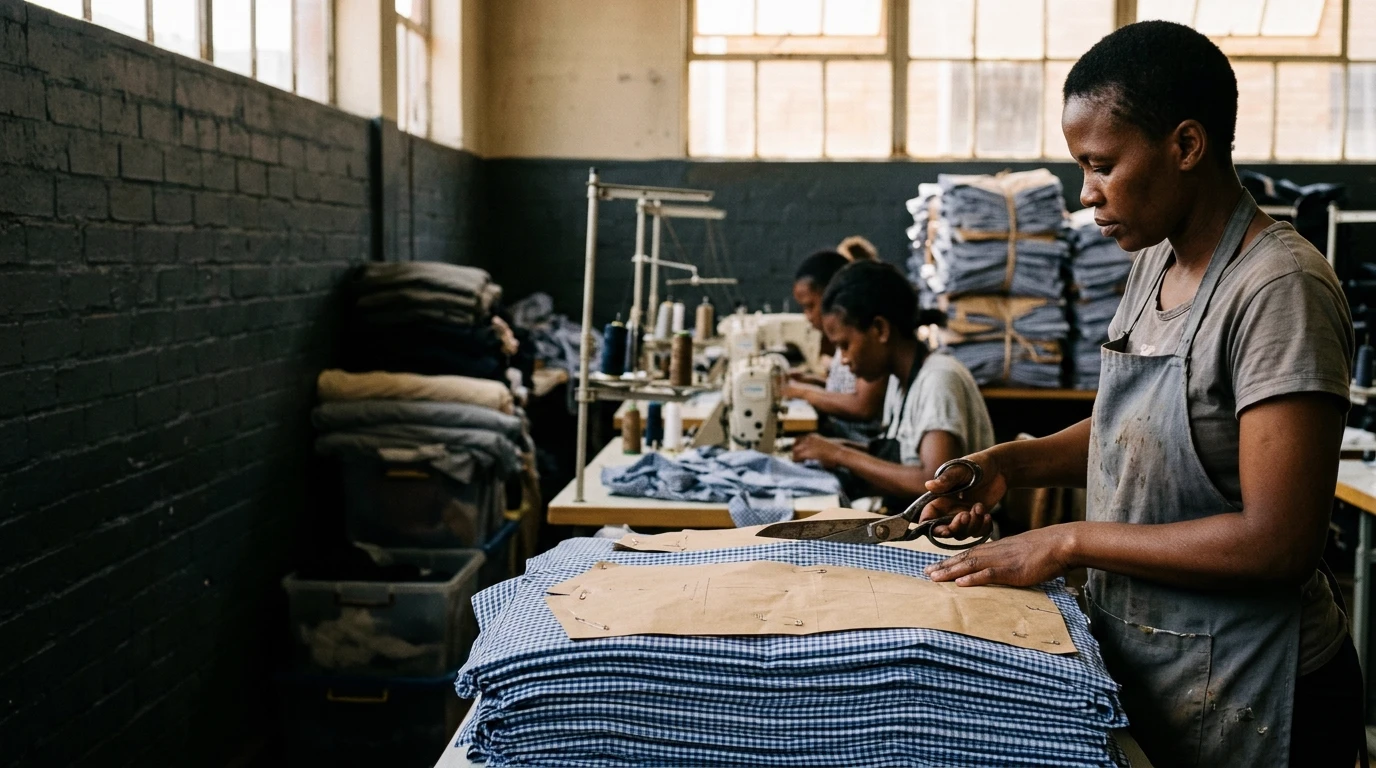
There is no honest single number. A full-school uniform order depends on the number of learners, the garment mix and the workshop’s load, so BMC Manufacturing confirms a production date in writing when it quotes. What usually decides the timeline is not the sewing — it is how quickly samples are signed off and learners are sized.
Last updated 30 October 2026. School term dates are from the 2026 public-school calendar; independent schools may differ, so confirm with your own school.
Ask ten suppliers how long a school uniform order takes and you will hear ten numbers. Most of them are guesses, and the ones that sound fastest are often the ones that slip.
This guide is for the principal, the school governing body (SGB) and the uniform committee planning a programme. BMC Manufacturing (Pty) Ltd cuts, sews, knits and embroiders school uniforms in Doornfontein, Johannesburg, so we will tell you where the time really goes — including the parts that are on your side of the table.
- Production time
- Depends on headcount, garment mix and workshop load; we confirm the date in writing on the quote.
- Slowest stages
- Sample sign-off and the sizing day slip far more often than cutting and sewing.
- Sizing deadline
- Public schools close on 9 December 2026, and sizing needs learners in the building.
- Slower garments
- Knitted jerseys and embroidered crests take longer than printed or plain sewn items.
- Top-up orders
- A short run once we hold your patterns, crest file and approved sample.
- Delivery format
- Full-school orders arrive sorted by grade and size.
What are the stages of making a school uniform, in order?
Nine stages, and only four of them happen on the factory floor. The rest are decisions, approvals and logistics — which is exactly why they are where the calendar slips.
| Stage | What happens | Who sets the pace |
|---|---|---|
| 1. Consultation and design | Colours, crest and the full item list agreed with the committee | School |
| 2. Quote and order | Unit prices, quantities and a written production date | Both |
| 3. Samples and sign-off | A physical sample of each garment is approved before the full run | School |
| 4. Sizing day | Learners measured on-site and matched to the school’s records | School |
| 5. Fabric and trims | Cloth, yarn, thread and buttons in the agreed colours | Manufacturer |
| 6. Cutting | Patterns graded by size and cut in layers | Manufacturer |
| 7. Sewing, knitting, embroidery, printing | Garments made and the crest applied | Manufacturer |
| 8. Quality check and bagging | Every batch checked, then bagged per learner or per size | Manufacturer |
| 9. Delivery | Sorted by grade and size for handover | Both |
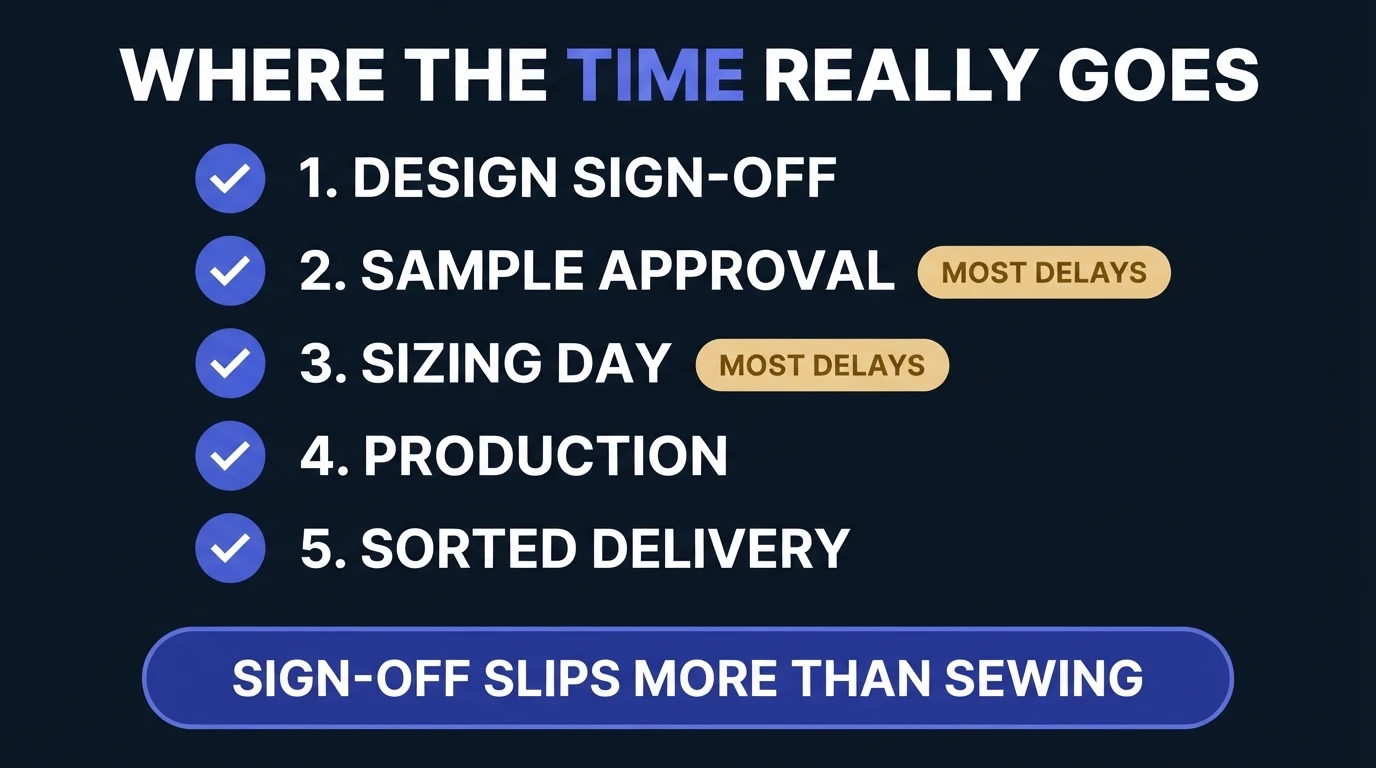
Notice that stages 1 to 4 all need the school. A committee that meets once a month can lose a month on a single question about a collar.
Why does sample sign-off take longer than the sewing?
Picture the committee meeting: the sample jersey goes round the table, someone thinks the maroon is too dark, and the decision moves to next month’s agenda. That one meeting can cost more time than cutting the whole order.
Sewing is predictable because it is our job and we do it every day. A sign-off depends on people who have day jobs, and who are rightly careful with other people’s money.
1. Waiting for the next meeting. Give one or two people the authority to approve samples between meetings.
2. Changing colour after sign-off. New fabric may have to be sourced, and anything already cut is wasted.
3. Redrawing the crest. The embroidery file is digitised from the artwork, so a new crest means a new file and a new sample.
4. Moving numbers. Quantities that keep changing make it hard to lock the cut. Size first, then confirm the order.
We bring physical samples to the school before anything is produced, because a photograph on a phone hides exactly the details — shade, weight, the feel of the knit — that start the arguments later.
Which school uniform items take the longest to make?
Knitted jerseys and anything with an embroidered crest. Knitting is its own process before a garment is even assembled, and every crest is a separate stitching run on every single item.
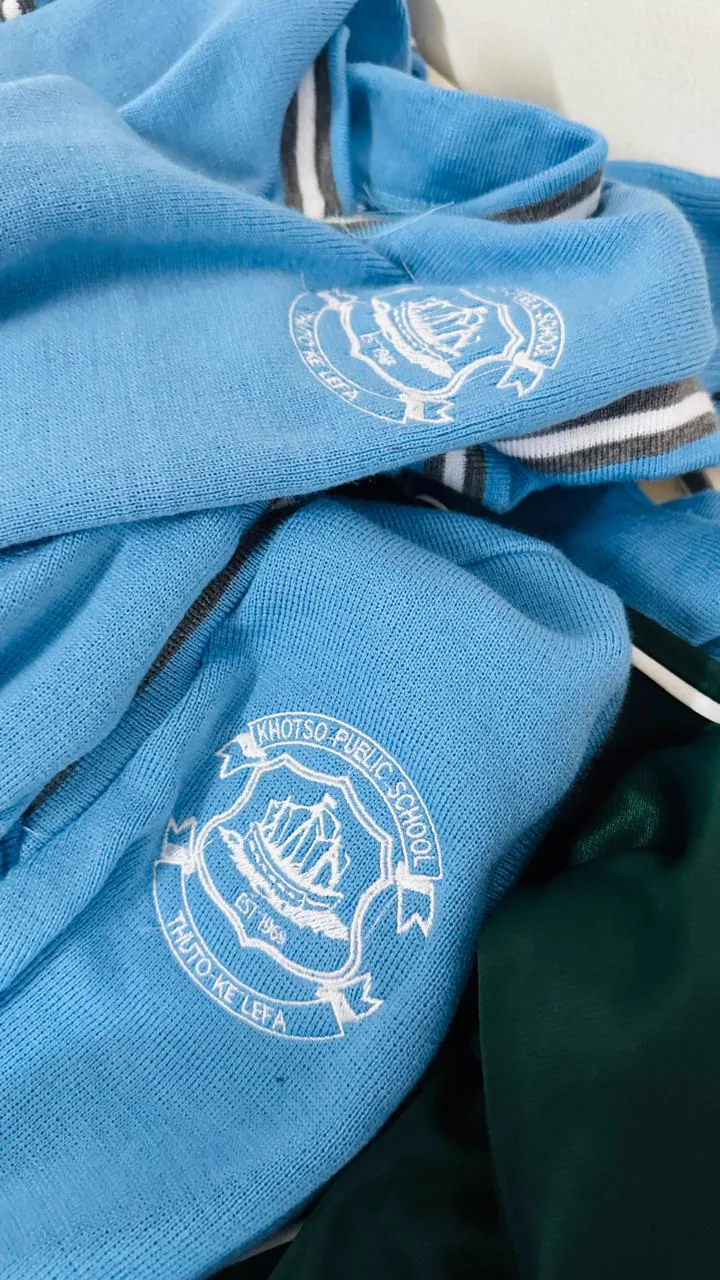
- Knitted jerseys and pullovers. The fabric is knitted to the school’s colours and trim, so yarn colour has to be right first.
- Embroidered items. Machine time grows with the number of garments carrying a crest, not just the number of learners.
- Tailored items like blazers. More pattern pieces and more construction per garment than a shirt.
- Shirts, skirts and tracksuits. Cut and sewn in volume; usually the most predictable part of the order.
That is why we would rather quote a date for your garment mix than publish a headline figure. Five hundred learners in shirts is a different job from five hundred learners in shirts, jerseys and tracksuits.

Is a top-up order faster than the first run?
Yes, and noticeably so. A top-up reuses patterns, a crest file and an approved sample that already exist, so it skips the design, sampling and full sizing stages entirely.
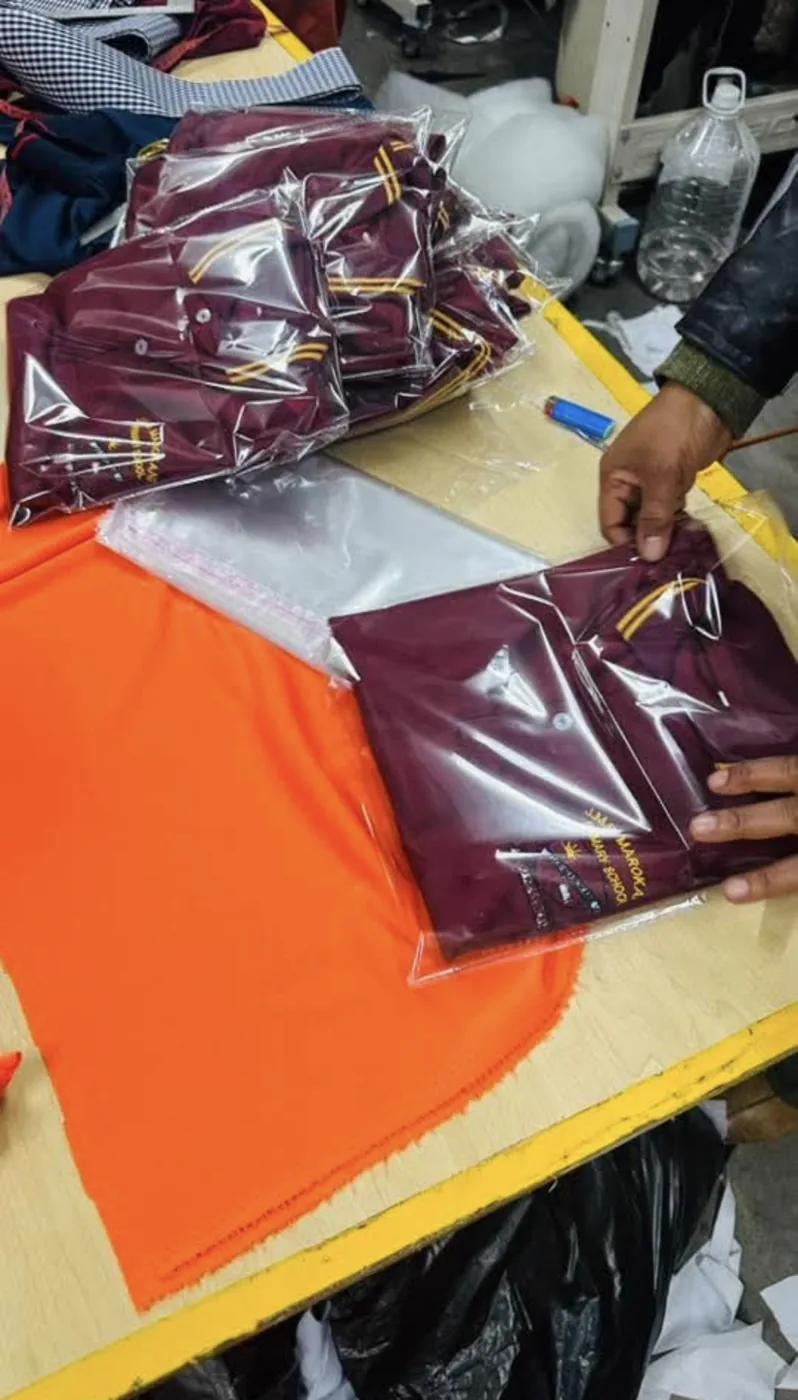
At JMB Marokane Primary, where we supply the full uniform programme for about 700 learners, mid-year top-ups for new learners do not wait for the next bulk production run. That is the practical benefit of sewing, knitting and embroidery happening under one roof.
The honest difference: a first run carries every decision the school has not yet made. A top-up carries none of them. If you are comparing suppliers, ask for the top-up turnaround as well as the first-run date — you will place far more top-ups than first orders.
What does the school control, and what do we control?
The school controls the decisions; the manufacturer controls the making. Both can sink the date, and it is worth agreeing in writing who owns what.
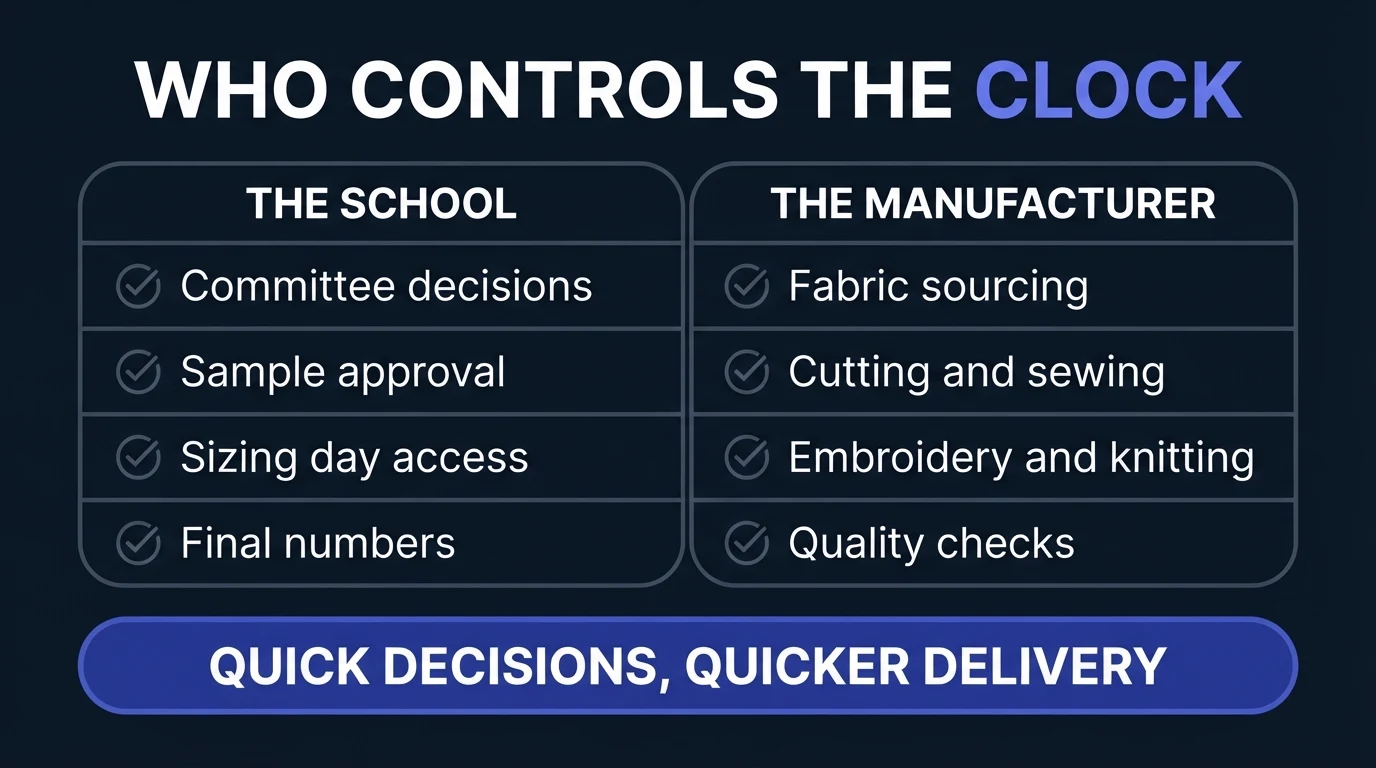
On our side, that means sourcing fabric in your colours, running every process in our own workshop, and quality-checking every batch before it leaves. You can see how that floor works on our about page.
On yours, it means one decision-maker for samples, a booked sizing day, and final numbers once sizing is done. Our guide to choosing a school uniform supplier lists what else belongs on the written quote.
Can you still get a full school order before January 2027?
It depends on how far along your committee already is. Public schools close on Wednesday 9 December 2026, according to the 2026 term 4 calendar, and a sizing day needs learners in the building.
- Samples already approved? Book the sizing day in November and confirm the order straight after it.
- Still choosing the design? Consider phasing: summer shirts and skirts first, jerseys and tracksuits as a second delivery.
- New Grade R and Grade 8 learners? They are not at your school yet. Size them separately at orientation rather than guessing.
If you need several hundred uniforms in two weeks, a manufacturer is not your answer — a retailer with stock already on the shelf is. We would rather say that now than miss a date in January. Our guide to when to order school uniforms sets out the full month-by-month plan.

- No honest supplier gives one number: headcount, garment mix and workshop load decide it.
- Get the production date in writing on the quote, tied to a sign-off date.
- Most delays happen before production: sample approval and the sizing day.
- Knitted jerseys and embroidered crests take longer than plain sewn items.
- Top-ups are faster than first runs because patterns and the crest file already exist.
Common questions
How long does it take to manufacture school uniforms?
It depends on the number of learners, the garment mix and the workshop’s load at the time, so there is no honest single figure. BMC Manufacturing confirms a production date in writing when it quotes. For most schools the slowest stages are sample sign-off and the sizing day, not the sewing itself.
Why do school uniform orders get delayed?
Most delays happen before production starts. Samples wait for the next committee meeting, colours or crest artwork change after sign-off, the sizing day is postponed, or learner numbers keep moving. Each change sends the order back a step. Once the fabric is cut, the schedule is far more predictable.
Are top-up orders faster than the first order?
Yes. A top-up uses patterns, a crest file and a signed-off sample that already exist, so it skips design, sampling and the full sizing day. At JMB Marokane Primary, mid-year top-ups for new learners do not wait for the next bulk production run. Ask for the top-up turnaround on the written quote.
Which school uniform items take the longest to make?
Knitted jerseys and embroidered items usually take longer than printed or plain sewn garments, because knitting is a separate process and every crest is a stitching run on every garment. A tailored item such as a blazer also needs more construction. The garment mix matters as much as the number of learners.
Can a school still get uniforms before January 2027?
It depends on how far along the school already is. Public schools close on 9 December 2026, and sizing needs learners in the building. A school with samples already approved can still size in November. One starting from scratch should consider phasing: summer items first, then jerseys and tracksuits as a second delivery.
Are full-school uniform orders delivered sorted by learner?
Yes. BMC Manufacturing delivers full-school programmes sorted by grade and size, and every batch is quality-checked before it leaves the Doornfontein workshop. Sizing runs are matched to the school’s own learner records, so nothing is guessed on delivery day.
What should a uniform quote say about timing?
It should give a written production date tied to a sample sign-off date, the delivery format, and the turnaround for top-up orders. A date given verbally on the phone is not a schedule. If a supplier will not put a date on the quote, ask why before you sign.
School dates: Gauteng school calendar 2026, term 4, checked 30 October 2026. Process: BMC Manufacturing schools programme and JMB Marokane case study.
Want a date you can hold us to?
Send Brian your learner numbers and the items on your list. You will get a written quote with a production date, a physical sample, and a date for the sizing day.