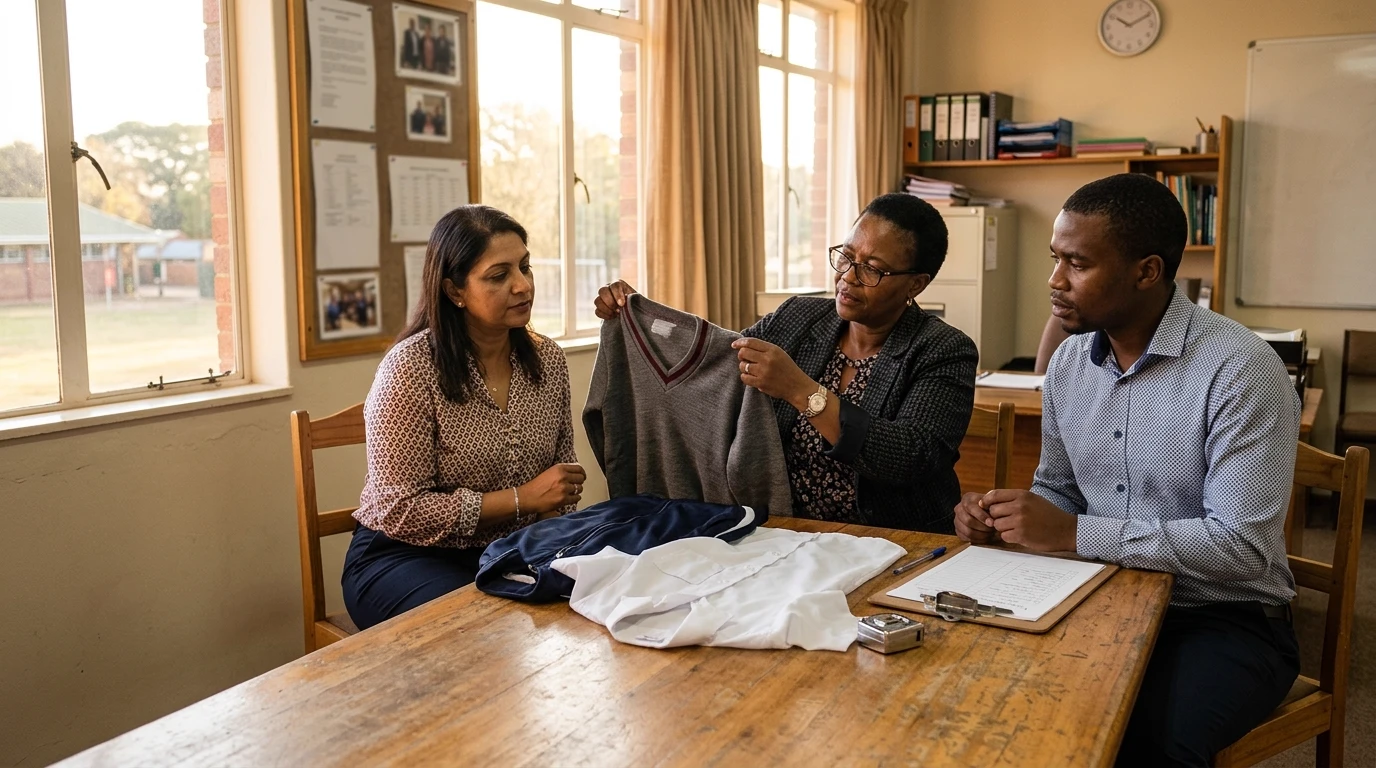
Choose a school uniform supplier by putting the same nine written questions to at least three suppliers. The two that matter most: how they handle a new learner’s uniform mid-year, and what delivery date they will put in writing. See a physical sample of every garment and visit the workshop before the governing body signs.
Last updated 7 October 2026. Prices quoted are from BMC Manufacturing’s published price list on that date and are indicative — they vary with fabric, quantity and specification.
Somebody on the school governing body (SGB) has been handed the uniform file. There are three quotes on the table, they all look similar, and the decision will be lived with for years.
This guide is for that person. BMC Manufacturing (Pty) Ltd makes school uniforms in Doornfontein, Johannesburg, so we are one of the suppliers you might be comparing. Put every one of these questions to us too — we have marked the ones we find hardest.
- How many quotes
- Compare at least three suppliers, answering the same questions in writing.
- The two that matter most
- Mid-year top-ups for new learners, and a delivery date in writing with a consequence if it is missed.
- Before signing
- A physical sample of every garment, signed off by the committee, and a visit to where it is made.
- Manufacturer or reseller
- Ask who cuts, sews, knits and embroiders the garments; only a manufacturer controls its own production dates.
- Exclusivity
- The Competition Commission’s guidance is to keep uniform generic, with more than one supplier, and exclusivity limited to necessary crest items.
- Best time to choose
- Before the term ends — October or November gives room to fix a wrong sample before January.
What are the 9 questions to ask a school uniform supplier?
Nine questions, each with an answer you can check. Put them in a short letter, send the same letter to every supplier on the shortlist, and ask for the replies in writing.
- Do you make these garments yourselves, or buy them in? Which items are cut and sewn on your own floor, and which are bought from someone else?
- Can we see a physical sample of every garment before we sign? Not a photograph — the actual jersey, shirt and tracksuit, with our crest on it.
- How will you size our learners? On-site at the school, from a size chart, or by parents guessing?
- What happens when a new learner arrives in May? How are mid-year top-ups ordered, priced and delivered?
- Will next year’s jersey match this year’s? How do you keep colour and crest consistent across garments and batches?
- What is the price per item, and what is included in it? Is the branding in the price? Is there a separate setup charge?
- What delivery date will you put in writing, and what happens if you miss it?
- Who owns our crest artwork and the embroidery file? Can we take it to another supplier?
- Can parents buy the plain items elsewhere? Which items, if any, do you expect to be exclusive, and for how long?
The fourth and the seventh are the ones that decide whether a school spends the next year fixing problems. They are covered in detail below.
What does a good answer sound like?
A good answer is specific, checkable and willing to be written down. A weak answer is a reassurance: “don’t worry”, “we’ve never had a problem”, “we’ll sort it out”.
| # | Question | A good answer | A red flag |
|---|---|---|---|
| 1 | Do you make it yourselves? | Names which items are made in-house and invites a visit | Vague about where garments come from |
| 2 | Physical samples? | A sample of every garment, with your crest, before signing | “It will look like the picture” |
| 3 | How do you size learners? | On-site sizing, or sample sets the school can use | Parents choose from a chart and hope |
| 4 | Mid-year top-ups? | A clear way to order small quantities, with a price and an indicative turnaround | “We’ll add it to next year’s run” |
| 5 | Colour and crest matching? | Explains how fabric and thread colours are kept consistent; keeps a retained sample | “It depends what the mill sends us” |
| 6 | Price per item? | Itemised unit prices with branding and any setup cost shown separately | One bundled total with no breakdown |
| 7 | Delivery date in writing? | A dated commitment, and what the school can do if it slips | “As soon as possible” |
| 8 | Who owns the crest artwork? | The school does, and gets the file on request | Silence, or a fee to release it |
| 9 | Can parents buy plain items elsewhere? | Yes; only crest items are supplier-specific | Every item must come from one counter |
How can you tell a manufacturer from a reseller?
Ask to see where the jerseys are knitted and the crests are embroidered. A manufacturer can walk you through its own floor. A reseller will usually talk about brands, stock and catalogues instead.
Neither is automatically better. A good reseller can offer more brands and ready stock on generic items, and for a school that only needs plain shirts that may be the right choice. Say so to your committee.
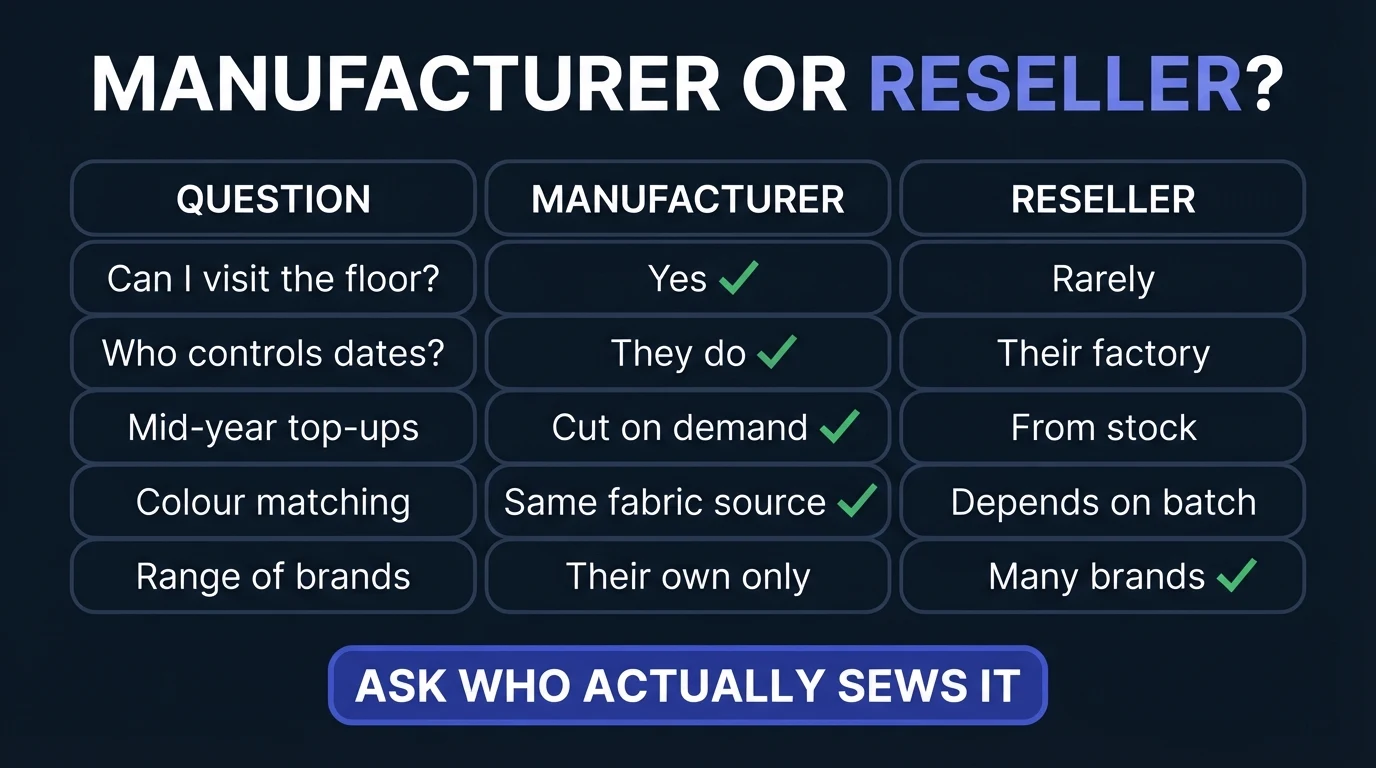
The difference shows up when something goes wrong. A manufacturer that cuts and sews in-house controls its own production dates. A reseller waits on somebody else’s factory, and so do you.
At BMC Manufacturing, sewing, embroidery, dye-sublimation and knitting all happen in one workshop on Silverwright Avenue, Doornfontein. You can read who does what on our about page — and you are welcome to come and see the floor before you decide.

Why is the mid-year top-up question the one that matters?
Picture May: three new learners transfer in, a Grade 4 has outgrown the tracksuit, and the uniform shop has none left in the school’s colours. What happens next depends entirely on the supplier you chose in October.
Top-ups separate suppliers who make garments from suppliers who only sell a bulk run. A supplier that produced one big batch in January may not restart for a handful of jerseys until next year.
Ask how small a top-up order can be, what it costs per item, and how long it takes. Get the turnaround as an indicative range in writing, because nobody can promise a fixed date for every possible order.
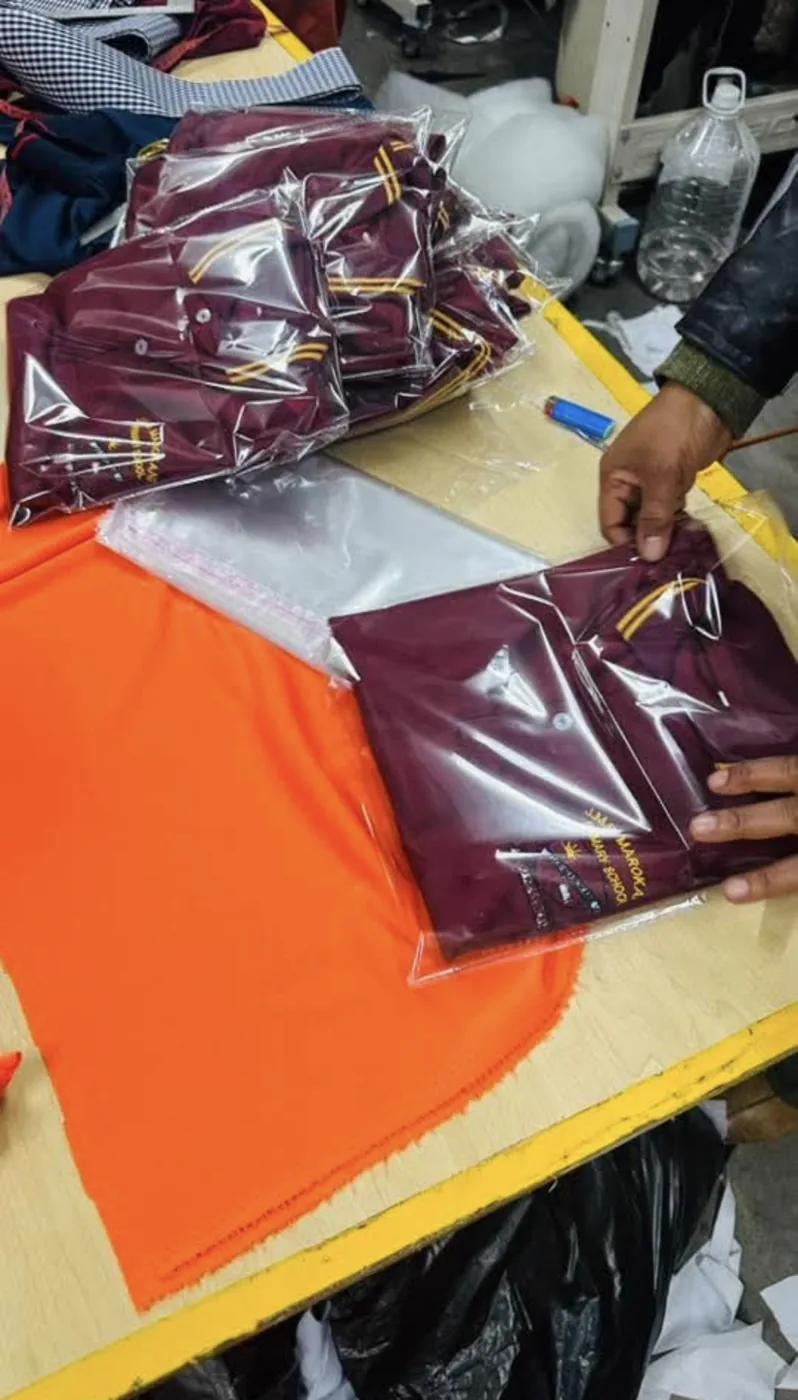
From our own work: top-ups for new learners through the year are part of the full uniform programme we run for JMB Marokane Primary School, where jerseys are knitted in-house and finished with the school’s embroidered crest. The JMB Marokane case study sets out how that programme works.
Will the jersey match the tracksuit, and next year’s batch?
Only if the supplier controls the fabric, the thread colours and the crest file. Mismatched maroons and slightly different crests are the most common complaint once a uniform has been in use for two years.
Ask how they keep colours consistent across knitwear, woven shirts and polyester tracksuits, which are different fabrics that take dye differently. Ask whether they keep a retained sample of each signed-off garment to match against.
The crest is easier to protect. Once it has been digitised for embroidery, the same file should stitch the same crest every time. Ask who holds it — which is question eight. Our guide to embroidery versus sublimation explains which finish suits which garment.
What should the price per item include?
Every quote should list each garment with its own unit price, and say whether branding is included. A single bundled total makes it impossible to compare suppliers line by line.
For comparison, here is what our published list shows as of October 2026. Prices may vary based on specific requirements, and all school items are branded with the school logo.
| Item | Indicative price |
|---|---|
| School shirt, short sleeve | R120 |
| School shirt, long sleeve | R180 |
| Jersey | R300 |
| Skirt | R250 |
| Blazer | R950 |
| Tracksuit, Grade R | R350 |
| Tracksuit, Grade 4–7 | R450 |
| Tracksuit, Grade 9–12 | R650 |
Bulk discounts start at 100 units, with better rates at 250 and 500. The full list and a quote builder are in the price estimator; the written quote is always the firm number.
What should you get in writing before signing anything?
Six things, every time. If a supplier will not put a promise on paper, treat it as a promise that was not made.
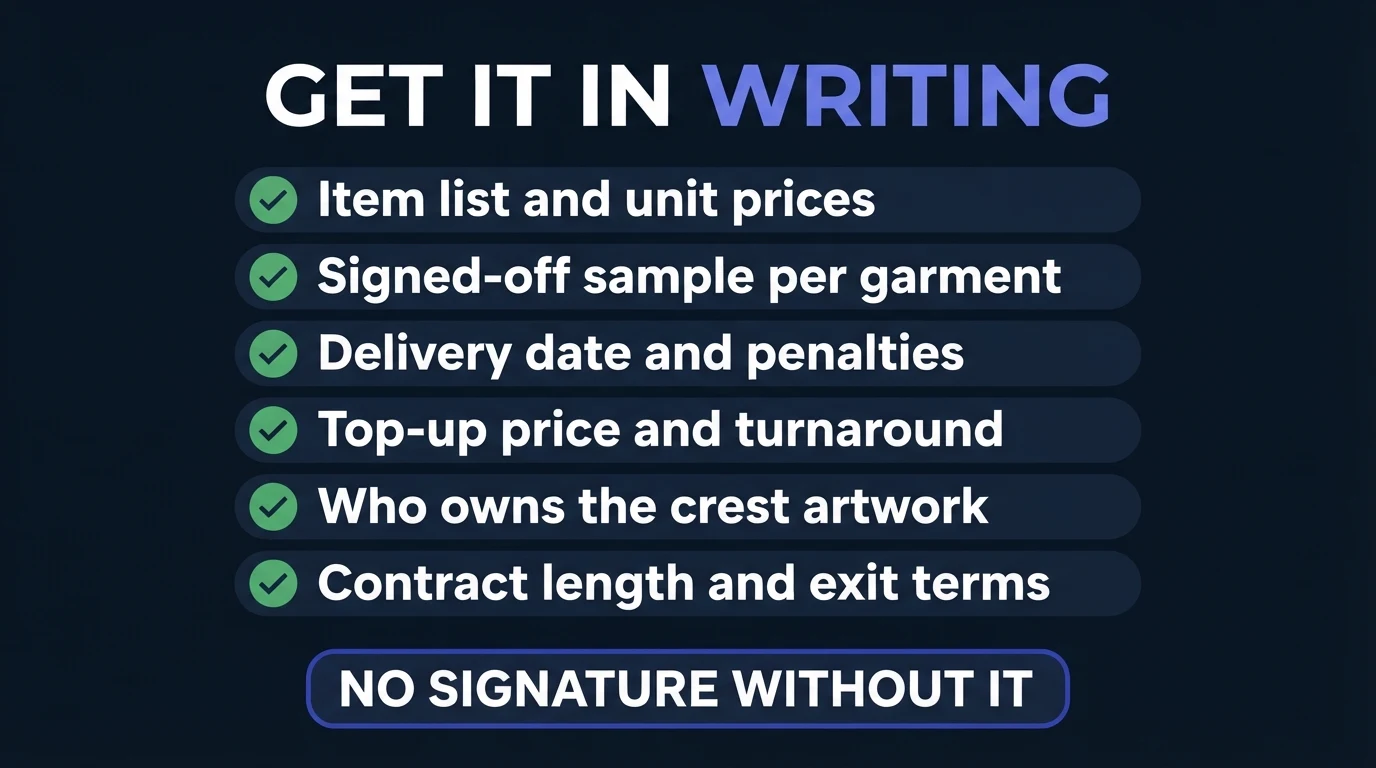
- The item list and unit prices, with branding and any setup cost on separate lines.
- A signed-off sample of every garment, kept by the school as the standard.
- The delivery date, and what happens if it is missed.
- The top-up price and an indicative turnaround for small mid-year orders.
- Ownership of the crest artwork and the embroidery file.
- Contract length and exit terms, including what happens to stock if you leave.
The Competition Commission’s guidance is that uniform should be as generic as possible, with more than one supplier, exclusivity kept to necessary crest items, and exclusive agreements kept short. Our guide on whether a school can force one uniform supplier links the source documents.
Which questions would a supplier like us struggle with?
Honestly: track record and a guaranteed lead time. A checklist every supplier passes nine out of nine is marketing, not a checklist, so here is where we are weaker.
We are a young company. BMC Manufacturing was registered in 2025 (2025/693696/07). We have uniformed more than 2 000 learners across 9+ schools, but a committee that wants ten years of references should weigh that, and is right to.
We do not publish a fixed lead time. It depends on volume and the garment mix, so we confirm it per quote. Ask any supplier for theirs in writing — including us.
And if your school only needs plain shirts and grey trousers, a good retailer or reseller may genuinely be the better choice. A manufacturer earns its place on crested knitwear, tracksuits and the top-ups that follow.
When should a school start comparing suppliers?
Before the term ends — ideally October or November. Quotes, samples and sizing take time, and every supplier is at its busiest in January.
Starting now leaves room to reject a wrong sample and try again, which is exactly the step a rushed committee skips. Our schools page sets out how a full programme runs, from committee meeting to delivery day.
- Send the same nine questions to at least three suppliers and compare the written answers.
- The two that decide the year: mid-year top-ups and a dated delivery commitment.
- See a physical sample of every garment and visit the workshop before signing.
- Ask who owns the crest file, and keep plain items available from more than one supplier.
- Get itemised unit prices — on our October 2026 list a jersey is R300 and a short-sleeve shirt R120, indicative and varying with specification.
- Start in October or November, not January.
Common questions
How do I choose a school uniform supplier?
Put the same written questions to at least three suppliers and compare the answers side by side. Ask whether they make the garments themselves, how they handle mid-year top-ups, what delivery date they will put in writing, and who owns the crest artwork. Ask for a physical sample of every garment and visit their workshop before the school governing body signs.
How can I tell if a uniform supplier is a manufacturer or a reseller?
Ask to visit the place where the garments are cut, sewn and embroidered, and ask who knits the jerseys. A manufacturer can show you its own floor and name the machines. A reseller will usually talk about brands and stock. Both can be good suppliers, but only a manufacturer controls its own production dates.
Should a school use more than one uniform supplier?
Usually, yes, for the plain items. The Competition Commission's guidance is that school uniform should be as generic as possible, with more than one supplier and exclusivity kept to necessary items such as crest pieces. A school can still appoint one supplier for its badged garments, through a fair and competitive process.
What should be in a school uniform supply agreement?
At minimum: the item list with unit prices, a signed-off sample for every garment, the delivery date and what happens if it is missed, the price and turnaround for top-up orders, who owns the crest artwork and embroidery file, and the contract length with exit terms. If a supplier will not write a promise down, treat it as not made.
How much does a school uniform cost from a manufacturer?
As of October 2026, BMC Manufacturing's published list shows a short-sleeve school shirt at R120, a jersey at R300, a blazer at R950 and a tracksuit from R350 for Grade R to R650 for Grades 9 to 12. All school items are branded with the school logo. Prices are indicative and vary with specific requirements.
When should a school start looking for a new uniform supplier?
Start before the term ends, not in January. Comparing quotes, signing off samples and sizing learners all take time, and the January rush means every supplier is busy at once. A school that settles its supplier in October or November gives itself room to fix a wrong sample before parents arrive at the counter.
Prices: BMC Manufacturing price estimator, School Basics and Jerseys, Hats & Accessories panels, checked 7 October 2026. All school items are branded with the school logo. Prices are indicative and may vary based on specific requirements. Competition Commission position as summarised, with source links, in our guide of 27 September 2026.
Put the nine questions to us
Send Brian your uniform list, your crest and a rough headcount. You will get written answers to all nine, an itemised quote, and an invitation to see the workshop in Doornfontein.