
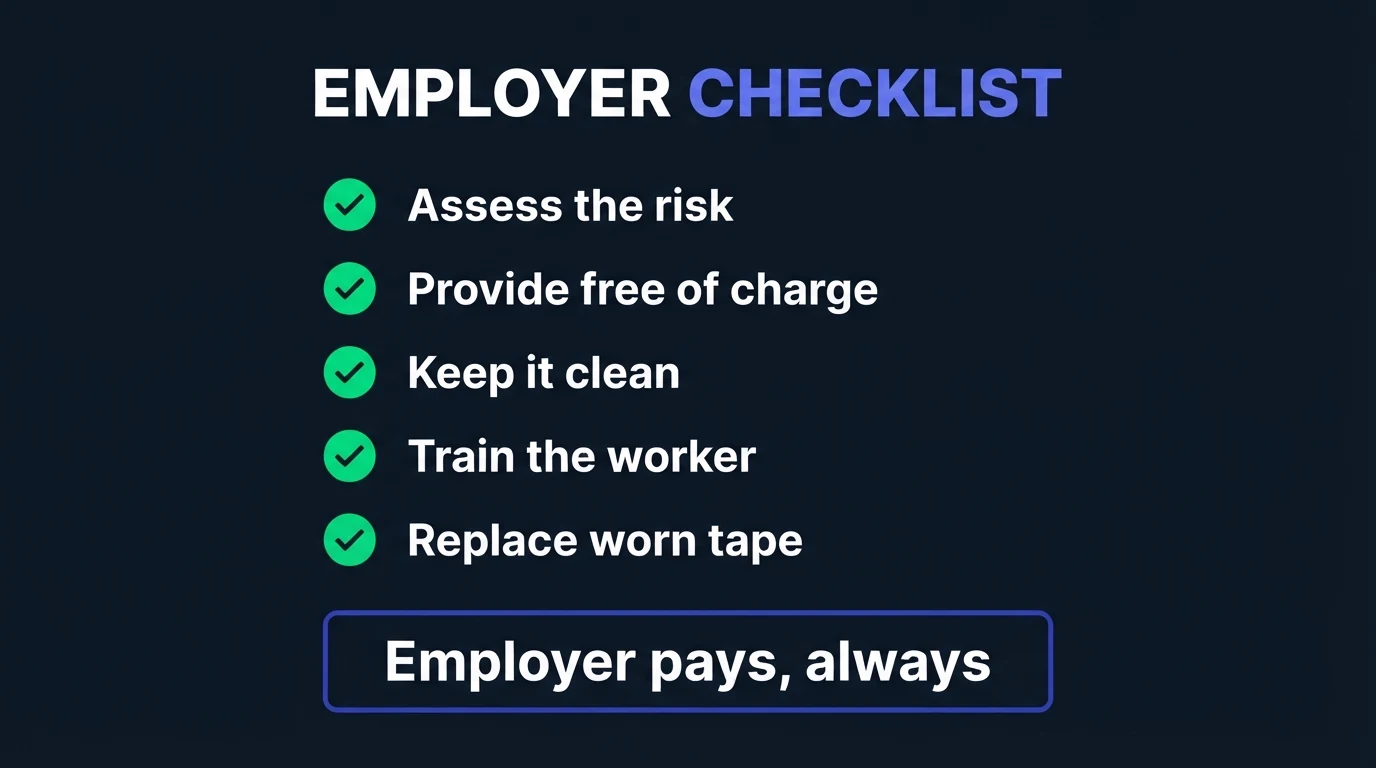
The employer pays. Under Regulation 2 of the General Safety Regulations, 1986, an employer must provide required safety equipment free of charge and keep it clean and in good condition. As of October 2026, BMC Manufacturing lists a reflective jacket at R350. Match the hi-vis class to your risk assessment, not to the cheapest vest.
Last updated 12 October 2026. Prices are from BMC Manufacturing’s published price list on that date and are indicative — they vary with specification and quantity. This is a practical guide, not legal advice: confirm the current regulation and your own risk assessment.
A new starter joins the yard on Monday. By Tuesday somebody asks the question every depot manager dreads: “who pays for the vest?”
This guide is for the business owner, safety officer or ops manager kitting out a crew. BMC Manufacturing (Pty) Ltd makes hi-vis workwear in Doornfontein, Johannesburg, so we sell what we are writing about. Where the cheaper option is the right one, we say so.
- Who pays
- The employer, free of charge to the worker, under Regulation 2 of the General Safety Regulations, 1986.
- Who decides what is needed
- The employer’s own risk evaluation of the work, not a catalogue.
- Hi-vis classes
- Class 1, 2 and 3 under EN ISO 20471, each with a minimum area of fluorescent and reflective material.
- Reflective jacket
- R350 per unit on our list — indicative, varies with specification.
- Vests and hi-vis shirts
- Not on our public price list — ask us for a current figure.
- Reflective tape
- It wears out with washing and abrasion, so budget for replacement.
What does the OHS Act say about who pays for hi-vis?
It puts the cost on the employer. Regulation 2 of the General Safety Regulations, 1986, made under the Occupational Health and Safety Act 85 of 1993, says that where a risk cannot be safeguarded, the employer must provide safety equipment free of charge and maintain it in a good and clean condition.
The same regulation says the employer must instruct workers in the proper use, maintenance and limitations of that equipment, and must not require or permit anyone to work without using it. The equipment may not be removed from the workplace except for cleaning, repair or replacement.
Subregulation (1), the risk evaluation duty, was substituted by Notice No. 6907 in Government Gazette 53783 on 5 December 2025. We read the regulation on 12 October 2026. Regulations change, so confirm the current wording against the official source and your own workplace risk assessment before you decide.
Which hi-vis class does your site need?
The class follows the risk: more vehicle speed and less light means a higher class. Classes come from the international standard EN ISO 20471, which sets a minimum area of fluorescent background material and reflective material for each.
| Class | Fluorescent material | Reflective material | Typically matched to |
|---|---|---|---|
| Class 1 | 0.14 m² | 0.10 m² | Lower-risk, slow-vehicle areas such as a yard |
| Class 2 | 0.50 m² | 0.13 m² | Roads and busier sites, including twilight |
| Class 3 | 0.80 m² | 0.20 m² | Fast traffic and poor light; must cover the torso and have reflective sleeves or trouser legs |
The “typically matched to” column is a rule of thumb used across the industry, not a legal ruling. Your risk evaluation decides. If a client or site specification names a class or a standard, send it to us before we quote and we will say plainly whether we can meet it.

“Hi-vis” on a label is not a class rating. Ask any supplier, us included, whether a garment is tested and certified to a class or simply made in fluorescent fabric with tape. We do not claim certification for any garment on this page.
Vest, jacket or reflective work shirt: which should you buy?
A vest for warm, short-exposure work; a jacket or shirt for crews outdoors all day. Sleeves put reflective material on the arms, which matters because arms move and are seen from the side.
| Garment | Best for | Weak point | Our list price |
|---|---|---|---|
| Hi-vis vest | Visitors, warm weather, short exposure | No sleeves, no warmth, easily lost | Not on our public list — ask us |
| Traffic / reflective jacket | Outdoor crews, cold mornings, roadside work | Hot in summer | R350 |
| Hi-vis work shirt | Daily wear in yards and depots; carries embroidery | Less warmth than a jacket | Not on our public list — ask us |
| Two-tone reflective overall | Workshop and yard staff in one garment | Whole garment goes when one part wears | Overall jumpsuit R800 |
Prices are indicative and may vary based on specific requirements. Bulk discounts apply from 100 units, with better rates at 250 and 500.
Be straight with yourself: if you need ten plain vests by Friday for visitors, an off-the-shelf workwear store is faster and cheaper. A manufacturer earns its place when you want matching, branded kit you can re-order.

What happens to reflective tape after a year of washing?
It wears out, and nobody budgets for it. Hot washes, abrasion and chemicals dull and crack reflective tape long before the fabric gives up. A garment with dead tape still looks hi-vis in daylight, but it is no longer doing its job at dusk.
We will not quote a lifespan, because we have not verified one and it depends on the tape and how it is washed. Instead:
- Ask for the tape maker’s wash rating in writing before you order.
- Inspect on a schedule. Cracked, peeling or grey-looking tape means the garment is due for replacement.
- Wash to the care label and keep hi-vis out of the hottest cycle.
- Plan a replacement line in the budget, because the employer must keep equipment in good condition.
What does it cost to kit out a crew?
About R700 per person for two reflective jackets on our October 2026 list, before any discount. Two each is the practical minimum — one on, one in the wash.
| Crew size | Jackets (two each) | Unit price | Total before discount |
|---|---|---|---|
| 5 people | 10 | R350 | R3 500 |
| 10 people | 20 | R350 | R7 000 |
| 25 people | 50 | R350 | R17 500 |
Prices may vary based on specific requirements, and a written quote is the firm number. Branding is embroidered in our workshop, and there is a once-off setup to digitise your logo. Get the lead time in writing on the quote.

What should you ask a hi-vis supplier before you order?
Five questions, in writing, before you pay a deposit.
-
Is it tested to a class, or just made in fluorescent fabric?
“Made to” and “certified to” are different claims. Ask which one you are getting, and for the paperwork.
-
What is the tape, and what is its wash rating?
Get the tape maker’s wash-cycle figure in writing.
-
Can I see a sample on a worker first?
Put it on someone for a full shift before you sign off the batch.
-
Can I re-order in the same fabric next year?
A cheap first order is expensive if the fabric is discontinued when you need a top-up.
-
What is the lead time, in writing?
Turnaround moves with a supplier’s load. Get the date on the quote.
The full range sits on our corporate and PPE workwear page, finished orders are in the production gallery, and our mechanic overalls buyer’s guide covers workshop kit. For depots and fleets, see logistics uniforms in Johannesburg.
- The employer pays for required safety equipment, free of charge to the worker, and keeps it clean and in good condition.
- Your risk evaluation decides what is required — confirm the current regulation.
- Class 1, 2 and 3 set minimum fluorescent and reflective areas; higher means more visible material.
- Our October 2026 list: R350 reflective jacket — indicative, varying with specification.
- Reflective tape wears out: ask for the wash rating and budget for replacement.
- Get the class claim, tape rating and lead time in writing.
Common questions
Who pays for hi-vis clothing in South Africa?
Under Regulation 2 of the General Safety Regulations, 1986, made under the Occupational Health and Safety Act, the employer must provide required safety equipment free of charge and keep it in a good, clean condition. That includes protective clothing where your risk assessment calls for it. Confirm the current wording and your own obligations before relying on this.
Can an employer deduct the cost of a hi-vis vest from wages?
Regulation 2 says the employer must provide required safety equipment free of charge, so passing the cost to the worker cuts against the regulation. Whether any deduction is lawful is a labour-law question we are not qualified to answer. Ask the Department of Employment and Labour or a labour-law adviser before deducting anything.
What is the difference between Class 1, 2 and 3 hi-vis?
Under EN ISO 20471, the classes set minimum areas of fluorescent and reflective material. Class 1 needs 0.14 m² fluorescent and 0.10 m² reflective, Class 2 needs 0.50 m² and 0.13 m², and Class 3 needs 0.80 m² and 0.20 m². A higher class means more visible material and suits a higher-risk setting.
Is a hi-vis vest enough, or do I need a jacket?
It depends on your risk assessment. A vest is cheap and cool, and it can reach a lower class on its own. A jacket or shirt with sleeves puts reflective material on the arms, which helps when a worker is seen from the side or moving. Cold mornings and rain usually decide it for outdoor crews.
How long does reflective tape last?
There is no single answer, and we will not invent one. Tape wears with every hot wash, abrasion and chemical exposure. Ask your supplier for the tape manufacturer's wash-cycle rating, inspect garments regularly, and replace any garment where the tape is cracked, peeling or dull. Budget for replacement rather than assuming a garment lasts for years.
Does BMC Manufacturing make hi-vis workwear?
Yes. We make reflective jackets, hi-vis work shirts, vests and two-tone reflective overalls in our Doornfontein workshop, with embroidered branding. As of October 2026 our reflective jacket is listed at R350. We do not claim certification for any garment here, so tell us the specification you need to meet and we will confirm what we can produce.
Sources, opened and checked 12 October 2026:
- General Safety Regulations, 1986 — Regulation 2, Personal safety equipment and facilities (Acts Online)
- EN ISO 20471 minimum areas by class (Fristads)
Prices: BMC Manufacturing price estimator, Industrial & PPE panel, 12 October 2026.
Kitting out a crew in hi-vis?
Send Brian your headcount and what your site needs to meet. You will get a written quote with the garment, the branding method and the discount band you fall into.