
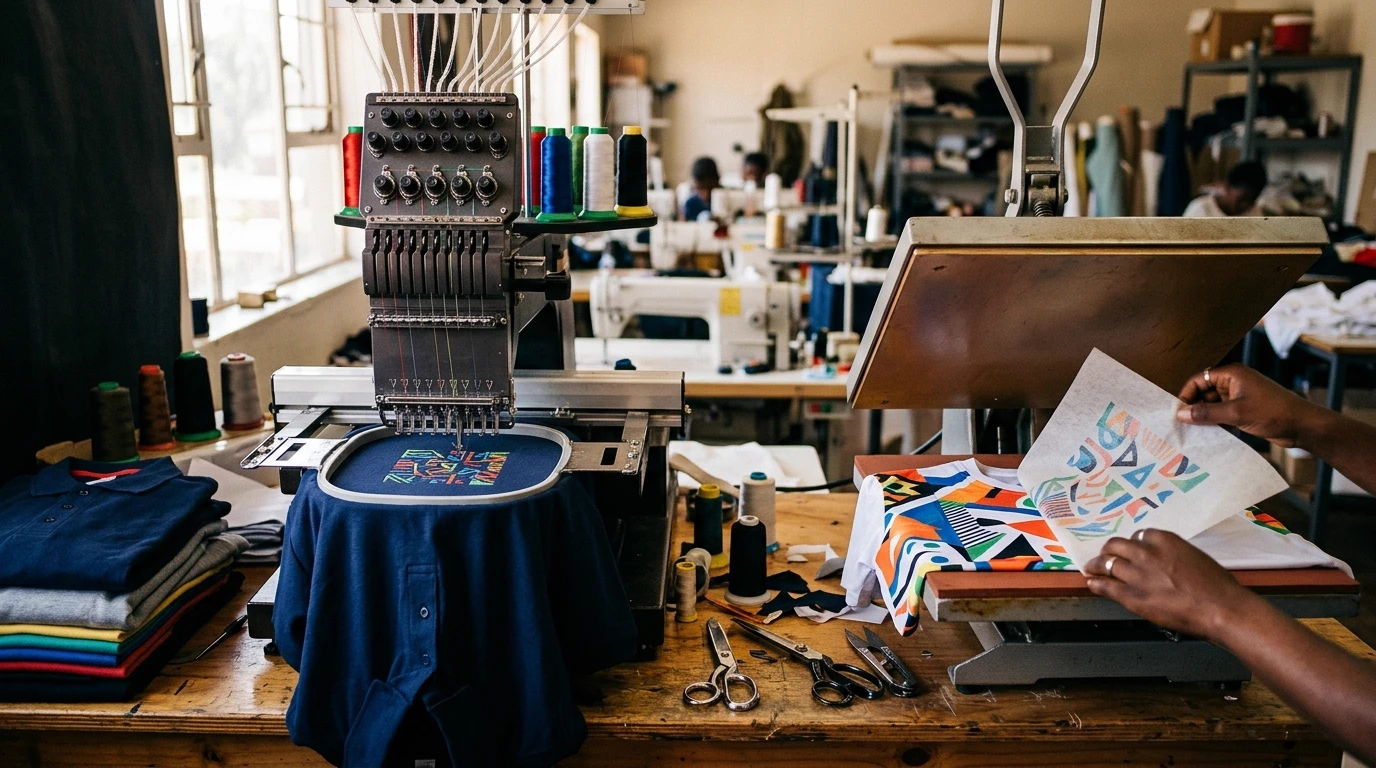
Choose embroidery for crests and logos on cotton, knitwear and blazers; choose sublimation for full-colour designs on polyester. Embroidery is stitched thread, looks formal and works on almost any fabric. Sublimation dyes artwork into polyester, so it handles unlimited colours but not cotton or dark garments. The fabric usually decides.
Last updated 2 October 2026. Prices are from BMC Manufacturing’s published price list on that date and are indicative — they vary with fabric, quantity and specification.
Somebody has a logo, a crest or a matric design, and two words keep coming up on every quote: embroidered or sublimated? They are not two versions of the same thing. They are different processes that suit different fabrics.
This guide is for the school, matric committee or business choosing how to brand a garment. BMC Manufacturing (Pty) Ltd runs both embroidery and dye-sublimation in our own workshop in Doornfontein, Johannesburg. We earn the same whichever you pick, which is the honest reason we can tell you when each one is wrong.
- Embroidery
- Thread stitched into the garment, giving a raised, textured finish that works on cotton, knitwear, twill and polyester.
- Sublimation
- Dye turned into gas by heat and bonded into polyester fibres, so the design becomes part of the fabric itself.
- Colour range
- Embroidery is limited to a set of thread colours; sublimation prints unlimited colours, gradients and photographs.
- Fabric rule
- Sublimation needs white or light polyester; it cannot print onto cotton or dark garments properly.
- Price signal
- On our list a sublimated school T-shirt is R300 against R180 for a normal T-shirt; an embroidered badge adds about R35 a garment in our estimator.
- Usual choice for crests
- Embroidery on jerseys, blazers, shirts and beanies; sublimation on sports kit, matric shirts and ties.
What is the actual difference between embroidery and sublimation?
Embroidery adds thread on top of the fabric; sublimation changes the colour of the fabric itself. Everything else — the look, the cost, the fabric rules — follows from that one fact.
An embroidery machine stitches your logo with thousands of individual stitches, one thread colour at a time. Your artwork is first converted into a stitch file, a step called digitising. The result is raised, has texture you can feel, and reads as formal.
Sublimation works the other way round. The design is printed onto transfer paper with special ink, then pressed against the garment under heat. The ink turns to gas and bonds into the polyester fibres. There is nothing sitting on top to peel or crack.
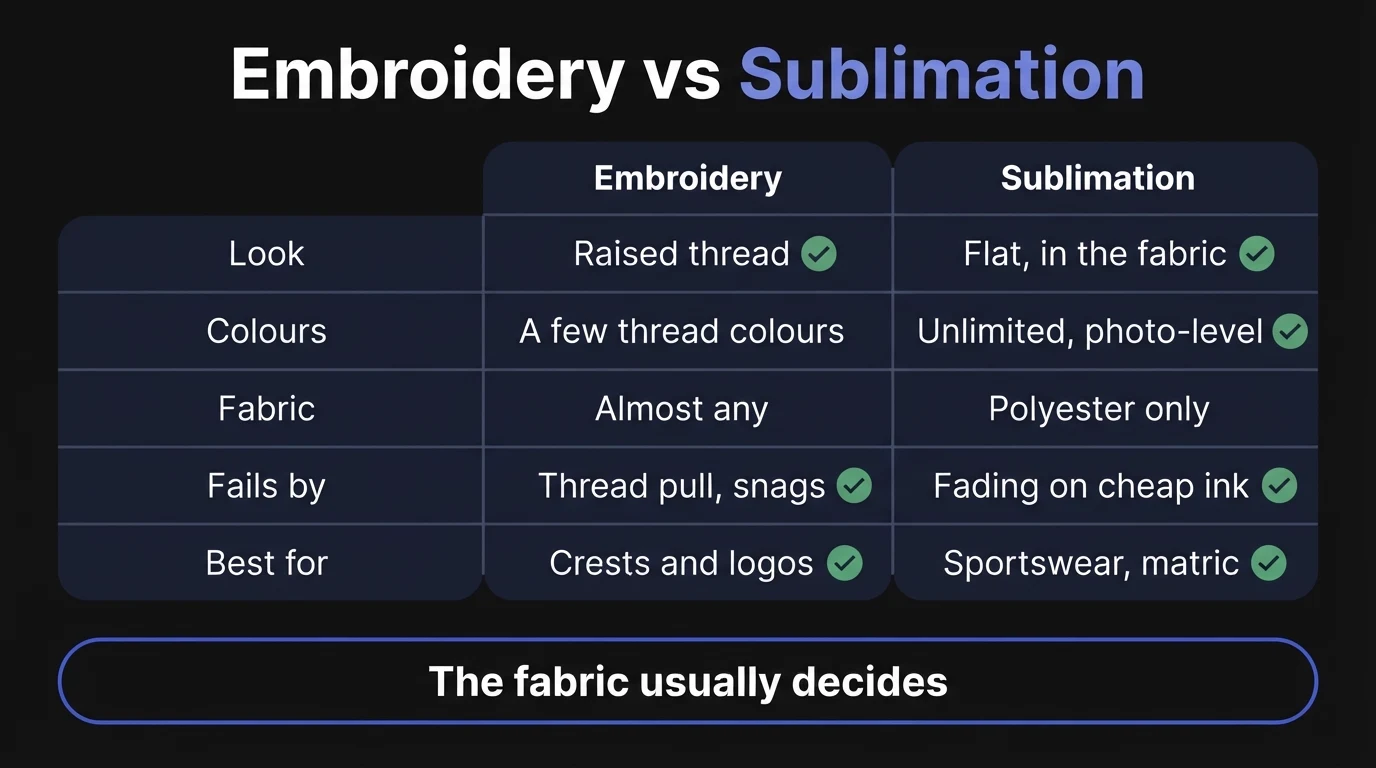
| Factor | Embroidery | Sublimation |
|---|---|---|
| How it is made | Thread stitched into the garment | Dye bonded into polyester fibres with heat |
| Look and feel | Raised, textured, formal | Flat, smooth, no feel on the fabric |
| Colour range | Limited to thread colours; no gradients | Unlimited colours, gradients and photographs |
| Fabric | Almost any: cotton, knit, twill, polyester | White or light polyester only |
| Design size | Best for a badge or logo | Can cover the whole garment, seam to seam |
| Durability | Lasts the garment if densely stitched; can snag | Will not peel or crack; quality depends on the polyester and the press |
| Individual names | Possible, priced per name | Easy, because each garment is printed individually |
| Indicative cost on our list | Embroidered badge about R35 extra a garment | Sublimated school T-shirt R300 vs R180 normal |
Prices may vary based on specific requirements. The figures above come from the price estimator on our home page, and the written quote is always the firm number.
Why does sublimation only work on polyester?
Because sublimation dye bonds with polyester fibres and has almost nothing to grip on cotton. Press a sublimation transfer onto a cotton shirt and most of the colour washes out within a few cycles.
Poly-cotton blends sit in between. The polyester part takes the dye and the cotton part does not, so the print comes out visibly paler and looks washed out from day one. Most decorators will not run sublimation on anything below a high polyester content, and neither do we.
The second rule surprises people. Sublimation cannot print white, because it is a dye, not a paint. It colours the fabric; it cannot cover it. That rules out bright artwork on a navy, black or maroon garment.
Cotton school shirts, knitted jerseys, blazers and dark golfers cannot be sublimated properly. If your garment is one of those, the choice is already made: embroider it.
Where does each one fail?
Picture a Grade 9 jersey in August, after six months of backpacks, playground fences and a weekly wash. Whether the crest still looks right depends on how it was made.
Embroidery fails by thread pull and snagging. A loose, low-density stitch catches on velcro, zips and bag straps, and a pulled loop is hard to fix. Very small text and fine detail also suffer, because thread has a minimum width. A badge with tiny lettering can blur into a smudge.
Thin fabric is the other risk. Heavy embroidery on a lightweight shirt can pucker the fabric around it if the backing is wrong.
Sublimation fails by fading, but mostly when it was done cheaply. Low-grade ink, an under-heated press, or a blend with too little polyester all produce a dull print that loses its punch in the wash. Properly done on good polyester, the design lasts as long as the garment.
There is one more weakness worth knowing. White creases can appear where the fabric was folded in the press, and those show on a full-colour design. A careful press operator prevents it; a rushed one does not.

Which is cheaper, embroidery or sublimation?
For a single logo, embroidery is usually cheaper; for full-colour, all-over designs, sublimation is usually the only option at all. They are rarely competing for the same job.
Our price estimator shows indicative per-garment branding add-ons of R35 for an embroidered badge, R45 for full-colour print and R20 for screen print. Embroidery also carries a once-off digitising setup for your logo, so ask for it on its own line in the quote.
Sublimated garments are priced as finished items, because the print and the fabric are one product. On our school list, a sublimated T-shirt is R300 against R180 for a normal T-shirt, and a sublimated tie is R150 against R120 for cotton. A matric tie in sublimation is R180.
| Item | Embroidered or plain | Sublimated |
|---|---|---|
| School T-shirt | R180 (normal T-shirt) | R300 |
| School tie | R120 (cotton) | R150 |
| Matric tie | — | R180 |
| Branding add-on per garment (estimator) | R35 embroidered badge | R45 full-colour print |
All school items are branded with the school logo, and prices may vary based on specific requirements. Bulk discounts start at 100 units, with better rates at 250 and 500.
Which do we use for school crests, and why?
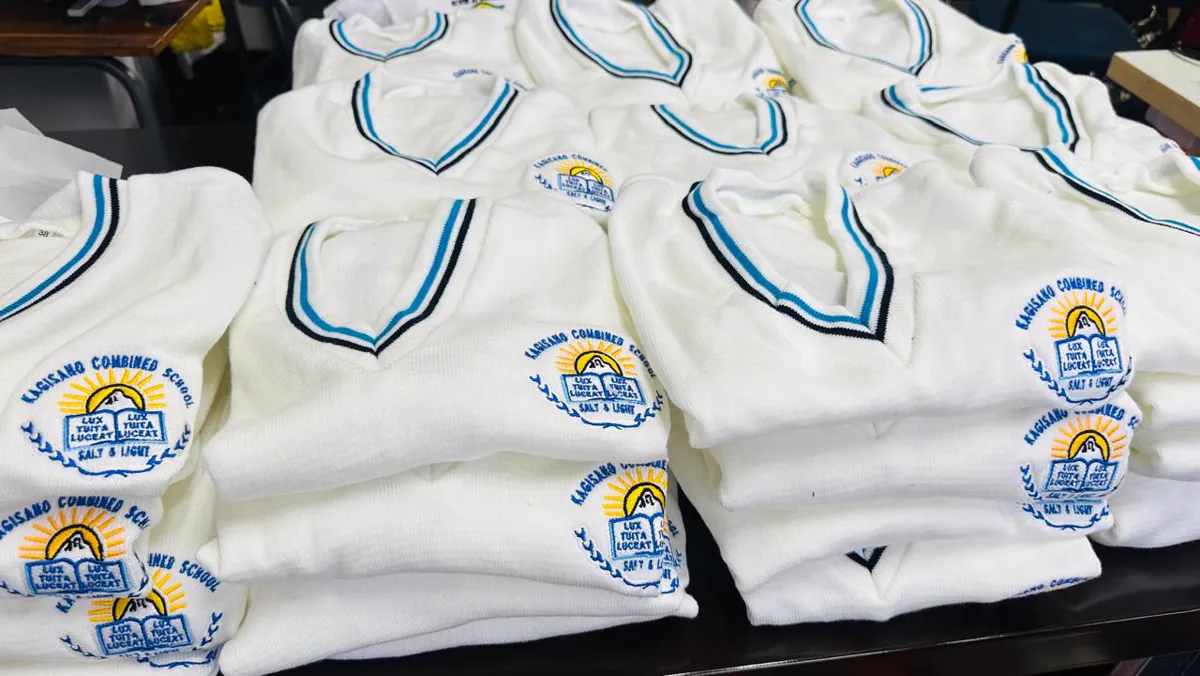
Embroidery, for nearly every everyday school garment. Jerseys, blazers, shirts, tracksuit tops, beanies and bucket hats are cotton, knit or dark fabric, and a stitched crest is what parents and SGBs expect a school badge to look like.
Sublimation earns its place on the garments that are polyester by design: sports kit, sublimated school T-shirts, ties and most matric shirts. On those, the crest is printed into the same artwork as the colours, stripes and names.
Matric wear is where the two meet. Many classes choose a sublimated design with every learner’s name, because each garment is printed individually and names cost nothing extra to vary. Others prefer an embroidered varsity jacket for the formal look. Our guide on what a matric jacket costs covers that decision in rand.
Should a business embroider or sublimate its logo?
Embroider the logo on golfers, work shirts and jackets; sublimate when the whole garment is the design. For most corporate wear, a neat embroidered chest logo is the standard and lasts the life of the shirt.
A fully sublimated golf shirt is a different product. It turns the shirt into a billboard in your brand colours, which suits events, promotions and teams that want to be spotted across a site.

If you are ordering for the first time, our guide to uniforms for a new business walks through what to order first. The gallery shows both finishes on real orders from our floor.
Is it worth asking a supplier that only does one?
Ask, but expect their answer to match their machine. A shop with only a heat press will lean towards sublimation, and a shop with only an embroidery machine will lean the other way. That is not dishonesty; it is what they can sell.
The questions that cut through it are simple:
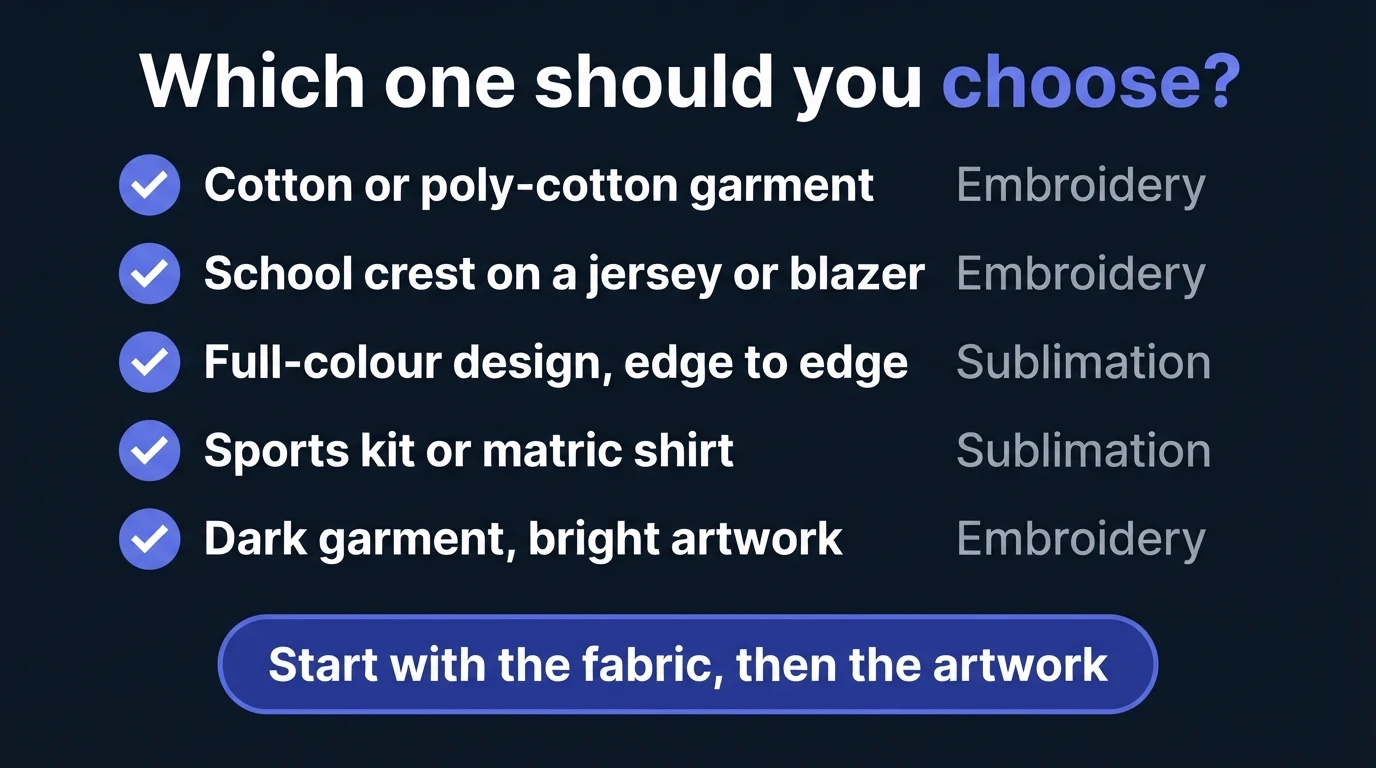
- What is the fabric? If it is cotton, knit or dark, sublimation is off the table.
- How many colours is the artwork? Gradients and photographs rule out embroidery.
- How small is the smallest text? Tiny lettering is a risk in thread.
- Can I see a sample on the actual garment? Not on a screen, on the fabric.
- Who holds the digitised file or artwork if I reorder next year?
We run sewing, embroidery, sublimation and knitting under one roof, which you can read more about on our about page. If you are a school weighing up a full programme, start with our schools page.
- Embroidery is stitched thread: formal, raised, and works on cotton, knit, twill and blazers.
- Sublimation dyes the design into white or light polyester: unlimited colour, but not for cotton or dark garments.
- For a school crest on everyday uniform, embroidery is the usual answer; for sports kit and matric shirts, sublimation.
- On our October 2026 list a sublimated school T-shirt is R300 against R180 normal — indicative, and varying with specification.
- Embroidery fails by snagging; sublimation fails by fading when done cheaply.
- Decide by the fabric first, then the artwork.
Common questions
Is embroidery or sublimation better?
Neither is better everywhere. Embroidery is better for crests and logos on cotton, knitwear, blazers and dark garments, because it is stitched thread and works on almost any fabric. Sublimation is better for full-colour, all-over designs on white or light polyester, such as sports kit and matric shirts. The garment's fabric usually decides.
Can you sublimate on cotton?
Not properly. Sublimation dye bonds with polyester fibres and has almost nothing to grip on cotton, so most of the colour washes out. Poly-cotton blends print paler because only the polyester part takes the dye. For cotton school shirts, jerseys and blazers, embroidery is the right choice.
Which lasts longer, embroidery or sublimation?
Both can last as long as the garment when done properly. Embroidery's weak point is snagging and thread pull, especially on loosely stitched designs. Sublimation will not peel or crack, but a cheap job on low-polyester fabric or with poor ink fades sooner. Ask to see a washed sample before you order a full run.
Is sublimation cheaper than embroidery?
Usually not for a single logo. As of October 2026, BMC Manufacturing's estimator shows an embroidered badge at about R35 extra per garment, plus a once-off digitising setup. Sublimated items are priced as finished garments, such as R300 for a sublimated school T-shirt against R180 for a normal one. Prices are indicative and vary with specific requirements.
Can you sublimate a dark or black shirt?
No. Sublimation is a dye, not a paint, so it can only add colour to light fabric and cannot print white. On a navy, black or maroon garment the design would barely show. For dark garments, embroidery or a different print method is needed.
Should a school crest be embroidered or sublimated?
On jerseys, blazers, shirts, beanies and tracksuit tops, embroider it: those fabrics are cotton, knit or dark, and a stitched crest looks like a school badge should. On polyester sports kit, sublimated T-shirts and ties, the crest can be sublimated as part of the design. Ask for a sample of each garment before sign-off.
Prices: BMC Manufacturing price estimator, School Uniforms panels and branding add-ons, checked 2 October 2026. All school items are branded with the school logo. Prices are indicative and may vary based on specific requirements.
Not sure which finish suits your garment?
Send Brian a photo of your logo or crest and tell him which garments it is going on. You will get a straight answer on embroidery or sublimation, and a written quote with any setup cost shown separately.