

Not for the whole uniform. The national school uniform guidelines discourage the “single supplier” approach, and the Competition Commission says uniforms should be as generic as possible, with more than one supplier and exclusivity limited to necessary items — typically crest items like a blazer or tie. Plain shirts, skirts, trousers and socks should be buyable anywhere.
Last updated 27 September 2026. Based on the National Guidelines on School Uniforms (Government Notice 173 of 2006) and Competition Commission documents published in 2021 and on 9 January 2026, all opened and checked on the date above. Rules change — confirm the current position with your school and the Commission.
Every January, some parent stands at a school uniform counter holding a till slip and asking the same question: why can I only buy this here? Sometimes there is a good answer. Often there is not.
This guide is written mainly for parents, with a section for the school governing body (SGB). One thing up front: BMC Manufacturing (Pty) Ltd makes school uniforms, so we benefit when schools open their supplier lists. We have kept this to what the documents say and linked every one of them, so you can check us.
- The national position
- The 2006 national guidelines aim at “discouraging the single supplier approach” where practical.
- What schools should do
- Keep the uniform as generic as possible and appoint more than one supplier, per the Competition Commission.
- What may be exclusive
- Only items the school regards as necessary to get from a preselected supplier — usually crest items such as ties and blazers.
- Contract length
- Exclusive agreements should run three to five years, after a competitive bidding process.
- Are the guidelines law?
- Not binding in the way an Act is, but the Competition Act is, and the Commission takes complaints.
- Where to complain
- The Competition Commission, using Form CC1 emailed to ccsa@compcom.co.za.
What do the national school uniform guidelines actually say?
They say schools may have a uniform, but it must not become a barrier to education — and that the single-supplier model should be discouraged. The guidelines were published by the then Minister of Education as Government Notice 173 of 23 February 2006, under section 8(3) of the South African Schools Act, and governing bodies must consider them when setting a uniform.
Five paragraphs matter most to a parent:
| Paragraph | What it says, in short | What it means for you |
|---|---|---|
| 4 | Costs are best reduced by fewer uniform options and, where practical, discouraging the “single supplier” approach | A one-shop-only uniform runs against the national aim |
| 9 | The uniform should not be an unaffordable financial burden on parents | Cost is a legitimate thing to raise with the SGB |
| 14 | No child may be refused admission for being unable to obtain or wear the uniform; SGBs should help learners who cannot afford one | A missing blazer is not a reason to turn a child away at enrolment |
| 16 | Individual interpretation of fabric, make and manufacturer should be allowed within a reasonably flexible guideline | A plain grey skirt from another shop should be acceptable if it matches |
| 26–27 | Parents must be told the estimated cost of a new uniform and invited to comment; major changes no more than every seven years | You get a say before a new uniform is adopted |
Note the careful wording: “where practical” and “should”. These are guidelines, not a ban. A school can still appoint a supplier. What it should not do is make the whole uniform available from one counter with no competition.
What did the Competition Commission add?
It turned the principle into four practical rules. The Commission says it had received complaints since 2010 about schools signing exclusive deals without any transparent or competitive bidding, investigated schools and suppliers from 2017, and published its school uniform guidelines in 2021.
- Generic first. School uniform should be as generic as possible, so it can be bought from many suppliers.
- More than one supplier. Schools should preferably appoint more than one, to give parents options.
- Exclusivity kept narrow. Only items the school regards as necessary to get from preselected suppliers.
- Short, competed contracts. Exclusive agreements should last three to five years and follow a competitive bidding process.
The Commission also asks schools to sign a voluntary “Undertaking to Comply with Competition Principles in School Uniform Procurement”. Schools that sign commit to competitive bidding, multiple suppliers, limited exclusivity and contracts of no more than five years.
Is it actually illegal for a school to use one supplier?
Not automatically. An appointed supplier chosen through a fair tender, for a limited list of crest items, for a few years, is exactly what the guidelines allow.
The honest picture of enforcement, from the Commission’s own January 2026 FAQ: some schools still have not adopted the guidelines, citing among other things that they are not compulsory. The Commission says it has not prosecuted any school as of that FAQ, though it reached settlements with various schools and large uniform suppliers after its 2017 investigation.
It also says it received 490 school uniform and learning-material complaints between 2020 and 2025, and resolved 465 of them. In other words: complaints get acted on, mostly by negotiation rather than court.
The Commission and the Department of Basic Education (DBE) are building a tool for schools to report their uniform suppliers and prices. The Commission said in January 2026 that it expects the tool to be in all schools before the end of 2026, and that it will use the data to spot exclusive agreements and excessive pricing.
Why is the crest the real lock-in?
Because anyone can sell a plain white shirt, but only the school’s appointed supplier can sell its blazer. The Commission notes that schools implementing the guidelines have typically treated items like ties, blazers and caps as their limited exclusive list.
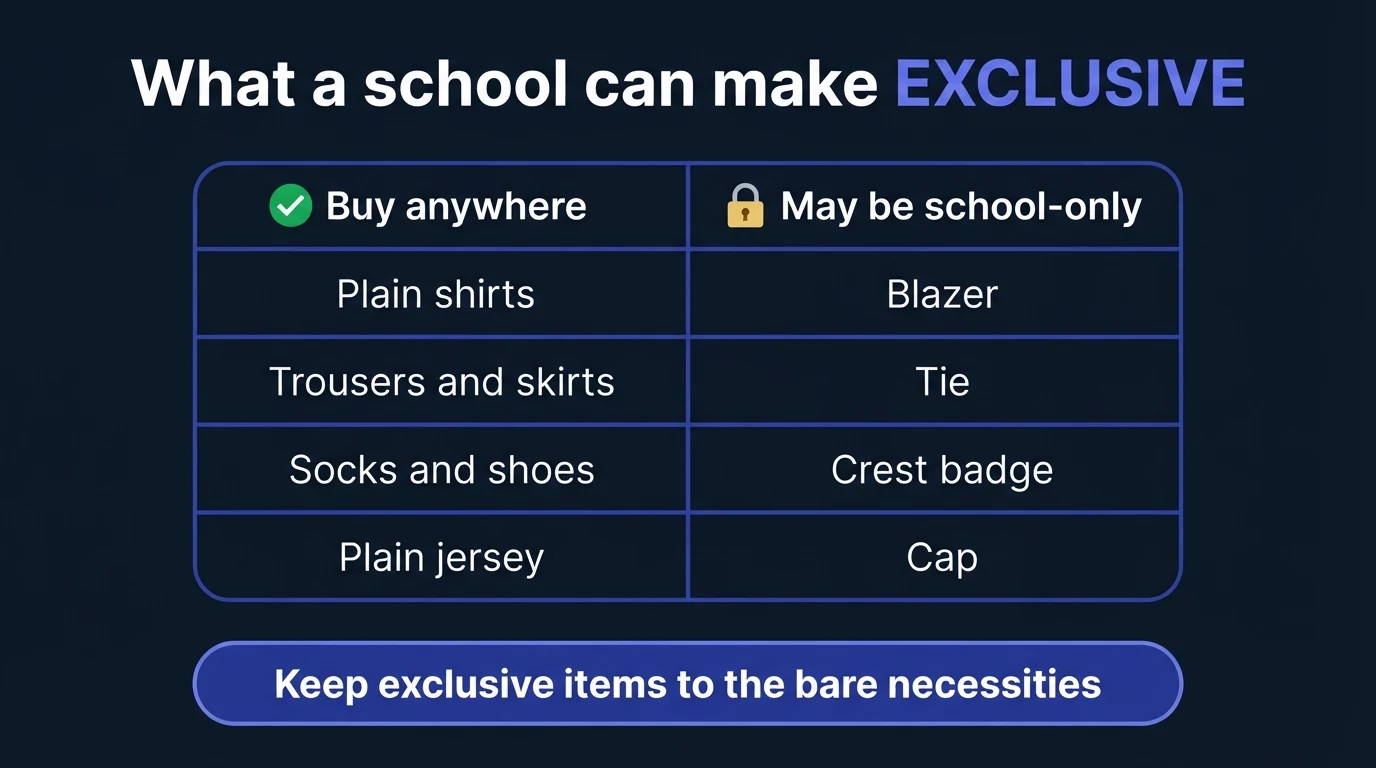
That split matters because the crest items are also the expensive ones. On our own published price list, as of September 2026, a school blazer is R950, while a short-sleeve school shirt is R120.
| Item | Usually | Our list price, crest included |
|---|---|---|
| Shirt (short sleeve) | Generic — buy anywhere | R120 |
| Shirt (long sleeve) | Generic — buy anywhere | R180 |
| Skirt | Generic, unless a school tartan | R250 |
| Jersey | Depends on the school’s colours and trim | R300 |
| Tie | Often school-specific | R120 cotton / R150 sublimated |
| Blazer | Often school-specific | R950 |
Our prices are indicative and may vary based on specific requirements; all our school items are branded with the school logo, and bulk discounts apply from 100 units, with better rates at 250 and 500. Full breakdown in how much school uniforms cost in South Africa.
If your school allows a plain shirt, a plain shirt from a chain store may well be cheaper than a branded one from us. Buy it there. A crest on an item that does not need one is exactly the cost the guidelines are trying to strip out.
What can a parent actually do?
Start with the school, in writing, and escalate only if that fails. Most of these situations are fixed by one well-put letter to the SGB.
-
Ask for the uniform policy and the supplier list
Request, in writing, which items are compulsory, which are school-specific, and which suppliers are approved for each.
-
Buy the generic items wherever you like
Match the colour and style. Paragraph 16 of the national guidelines allows flexibility in fabric, make and manufacturer.
-
Ask whether the school has signed the Commission’s undertaking
If not, ask the SGB why not. It is a voluntary, public pledge and a fair question at a parents’ meeting.
-
Raise cost at the annual parents’ meeting
The guidelines say uniform cost should not be an unaffordable burden, and that parents should be consulted on the estimated cost of any new uniform.
-
If nothing changes, complain to the Competition Commission
Complete Form CC1 from compcom.co.za and email it to ccsa@compcom.co.za, or WhatsApp 084 743 0000 with a short description.
And if the real problem is that you cannot afford the uniform at all: say so to the school. The guidelines ask SGBs to help such learners and strongly encourage school-run second-hand shops.
Should an SGB drop its exclusive supplier?
Not necessarily — but it should re-compete it, narrow it and put an end date on it. There are real reasons schools like one supplier: colours match across batches, crests are consistent, and mid-year top-ups come from the same place.
Those benefits do not need a decades-long monopoly. They need a clear fabric and colour specification, a competitive process every three to five years, and an exclusive list limited to what genuinely carries the crest. That is also the position that survives a parent’s complaint.
If your SGB is reviewing its arrangement this term, our school uniform programme page explains how we quote, sample and size — and we are equally happy to be one of several appointed suppliers.
Where does that leave a supplier like us?
Better off, frankly. A school that opens its list to competition is a school we can actually quote for. We manufacture in our own workshop in Doornfontein, Johannesburg, and would rather win on price and service than on a contract nobody can challenge.
You can read who we are and how our workshop runs, and if you are a parent, Uniform Zone is our retail side for buying a set or two.
- A school may have a uniform, but should not make all of it single-supplier.
- Generic items — shirts, skirts, trousers, socks — should be buyable anywhere that matches the spec.
- Exclusivity is meant for necessary crest items, like a blazer or tie.
- Exclusive contracts should be competed and last three to five years.
- The guidelines are not binding like an Act, but the Competition Commission acts on complaints.
- No child may be refused admission for being unable to obtain the uniform.
Common questions
Can a school force parents to buy uniforms from one shop?
Not for the whole uniform, if it follows the national guidance. The 2006 national guidelines discourage the single-supplier approach, and the Competition Commission's 2021 guidelines say generic items should be obtainable from many suppliers. A school may still require some crest items, such as a blazer or tie, from an appointed supplier.
Are the school uniform guidelines law?
Not in the way an Act is. The 2006 national guidelines were issued under section 8(3) of the South African Schools Act and governing bodies must consider them. The Competition Commission's own January 2026 FAQ notes that some schools cite the guidelines not being compulsory. The Competition Act itself, however, is law.
Which uniform items can a school make exclusive?
The Competition Commission says exclusivity should be limited to items the school regards as necessary to get from preselected suppliers. In practice schools have used this for items such as ties, blazers and caps that carry the crest. Plain shirts, trousers, skirts, socks and shoes should be buyable anywhere that matches the specification.
How long can a school's exclusive uniform contract last?
The Competition Commission's guidelines say exclusive agreements should be of limited duration, between three and five years, and should follow a competitive bidding process. Schools that sign the Commission's voluntary undertaking commit to contracts of no more than five years and to appointing multiple suppliers.
How do I report a school with an exclusive uniform supplier?
Complete a Form CC1 from the Competition Commission's website and email it to ccsa@compcom.co.za with a short description, or send a WhatsApp to 084 743 0000. Raise it with the school governing body first, because many schools fix the problem once it is put to them in writing.
Can a school refuse to admit my child without the full uniform?
The national guidelines say no child may be refused admission because of an inability to obtain or wear the school uniform, and that governing bodies should try to help learners who cannot afford one. Refusing to wear the approved uniform can still be treated as a disciplinary matter under the school's code of conduct.
Is buying from the school's appointed supplier always more expensive?
No. An appointed supplier chosen through a competitive tender can be good value, and it usually guarantees that colours and crests match. The problem the guidelines target is an exclusive deal signed without competition and left running for years, which removes any pressure on price.
Sources, all opened and checked 27 September 2026:
- Government Gazette 28538, Government Notice 173 of 2006 — National Guidelines on School Uniforms (PDF, South African Government)
- Competition Commission — School Uniform Guidelines brochure (PDF)
- Competition Commission — Procurement of School Uniform & Learning Material Guidelines FAQ, 9 January 2026 (PDF)
- Competition Commission — School uniform guidelines page
Reviewing your school’s uniform supplier?
Send Brian your item list and learner numbers. You will get a written, itemised quote you can put next to your current supplier’s — useful whether or not you choose us.